
Watch and Clock Repair Blog
Before quartz. Before smartwatches. Before marketing turned every timepiece into a lifestyle accessory, there was Léon Hatot—a man who believed that watches could do more than tell time. They could speak it. Shape it. Electrify it.
 Born in 1883 in Châtillon-sur-Seine, Hatot quickly outgrew the confines of his provincial roots. He studied at the prestigious École d’Horlogerie in Besançon, but it wasn’t long before Paris called. There, Hatot became a rising star—an artist of both time and form. By 1911, he had acquired the respected Bredillard firm, giving him not just design mastery but manufacturing muscle. And what he did with it changed French watchmaking forever.
Hatot’s world was the roaring 1920s—a time of jazz, geometric elegance, and a thirst for modernity. He thrived in the Art Deco era, designing slender platinum watches for women that doubled as jewelry, combining meticulous mechanical movements with diamonds, sapphires, and bold lines. His creations were worn not just to be seen—but to be remembered.
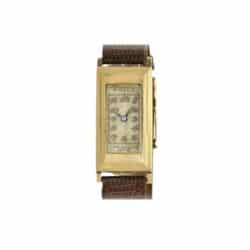 But while most were content designing for the wrist, Hatot had a bigger idea. What if time could be electric? In 1923, he introduced the ATO brand and unveiled electromagnetic clocks powered by batteries—a radical departure from winding stems and mainsprings. These sleek, minimalist clocks showed up in train stations, embassies, and public halls across France. Hatot had modernized not just the form of timekeeping, but its function. In 1925, he was awarded the Grand Prix at the Paris Exposition Internationale des Arts Décoratifs—and the Légion d’Honneur soon after.
Behind the scenes, he was also quietly supplying movements and artistry to Cartier, Van Cleef & Arpels, Boucheron, and other luxury houses. Hatot wasn’t always the name on the dial—but his fingerprint was everywhere. His company became a hidden engine behind the golden age of French horology.
Then the silence came. War disrupted the flow of luxury. Innovation took a backseat to survival. Hatot passed away in 1953, and with him, the electricity of the brand dimmed. The stepping motor he helped pioneer would live on in quartz technology, but the name Léon Hatot gradually faded into the footnotes.
Until 1999.
 That year, the Swatch Group unearthed a forgotten treasure: Hatot’s design archives—over 5,000 original sketches and models, frozen in time. They saw potential in reviving the brand, not as a mass-market name but as a boutique maison of high-art timepieces. The new Léon Hatot was marketed as feminine, refined, and unapologetically elegant. Watches like La Garçonne, inspired by the free-spirited flapper era, and the Heartbreaker chronograph, with a heart-shaped window revealing its beating movement, showcased the brand’s emotional and architectural soul.
There was even a bold Moon Phase Chronograph, layering time complications within a deconstructed, modernist case. Each release carried Hatot’s DNA: a devotion to beauty, to rhythm, to resonance.
And yet, something didn’t catch. Perhaps it was the crowded market. Perhaps it was the quiet rollout. Despite its heritage and craftsmanship, the revival didn’t ignite the way others had. By the end of the 2000s, Léon Hatot went silent again.
Today, the brand exists more as a legend than a logo—but one worth revisiting. Léon Hatot’s legacy isn’t just in the watches he signed. It’s in the very idea that time should do more than tick—it should stir. He gave us time as art, as energy, as emotion. And in that, his spark still lives on.