
Benrus never really disappeared.
The company did. The watches didn’t.
For decades after Benrus collapsed during the Quartz Crisis, collectors continued searching for the watches that had made the brand famous. Military enthusiasts hunted for Type I and Type II dive watches originally issued to elite U.S. military personnel. Vietnam-era field watches remained sought after by collectors who appreciated their no-nonsense design and military history. Vintage Sky Chief chronographs quietly changed hands among enthusiasts who knew exactly what they were looking at. Long after the company itself had faded, the watches continued building the legend.
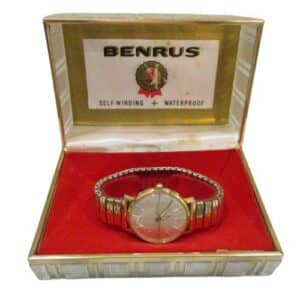 That legend began in New York City in 1921 when brothers Benjamin, Oscar, and Ralph Lazrus founded Benrus. Over the next several decades, the company grew into one of America’s most successful watch brands by combining Swiss watchmaking with aggressive American marketing. Benrus sponsored celebrities, athletes, and aviators. Its watches appeared on military wrists, in department stores, and eventually in homes across the country. By the 1950s and 1960s, Benrus stood alongside Hamilton, Bulova, and Elgin as one of the best-known names in American horology.
Then the industry changed almost overnight.
The arrival of inexpensive electronic watches devastated traditional manufacturers throughout the 1970s. Benrus filed for bankruptcy in 1977 and again in 1981. The company that had once employed hundreds and sold millions of watches effectively ceased to exist. What remained was a valuable trademark that would spend the next several decades moving from owner to owner. Clinton Watch Company controlled the name for a period, followed later by M.Z. Berger, which also owned other historic American watch trademarks. Although watches bearing the Benrus logo occasionally appeared, they were largely disconnected from the company that had earned the brand’s reputation.
Yet something unusual happened while Benrus sat dormant.
Its military watches became more desirable.
As interest in vintage military timepieces exploded during the 1990s and 2000s, collectors increasingly focused on Benrus. Original Type I and Type II watches became some of the most discussed American military watches of the Cold War era. The company’s Vietnam-era field watches gained appreciation for their authenticity and historical significance. The #3061 diver attracted attention because of its connection to Steve McQueen in Bullitt. Ironically, the further Benrus drifted from public view, the stronger its reputation became among collectors.
That growing interest convinced Giovanni Feroce that the brand deserved another chance.
In 2014, the former Alex and Ani executive acquired rights associated with the Benrus name and announced plans to revive it. His vision extended far beyond watches. He imagined Benrus as a modern American lifestyle company built around heritage, with watches serving as only one part of a larger ecosystem that included apparel, accessories, retail stores, and licensing opportunities. It was a bold strategy, and for a brief moment it appeared to have momentum.
Then it collapsed.
Financial disputes emerged, legal battles followed, and by 2017 the project had unraveled. Control of the trademarks changed hands, court actions restricted use of the brand, and Benrus found itself back where it had been so many times before: uncertain of its future.
Most brands do not survive one collapse.
Benrus was now facing its second.
The difference was that this time, the people taking over understood exactly what collectors wanted.
In late 2017, a private investment group led by New York attorney Michael Sweeney acquired the Benrus intellectual property and began evaluating what came next. Sweeney and his team quickly recognized something that previous revival efforts had missed. Collectors were not asking for a Benrus lifestyle brand. They were not asking for fragrances or clothing lines. They wanted the watches that had made Benrus famous.
Rather than reinventing the company, the new ownership decided to rebuild it around its strongest historical assets.
To help accomplish that goal, Sweeney brought in veteran watch executive Michael Goeller, formerly of Bulova. Together, they established modern Benrus headquarters in New York and began researching the company’s archives, military history, and surviving vintage models. The objective was not simply to reproduce old watches. The objective was to understand why those watches mattered in the first place.
The strategy became clear with the relaunch.
 Instead of introducing dozens of unrelated models, Benrus focused on the watches collectors already respected. The Type I returned as a modern Swiss-made interpretation of the military dive watch that had become one of the most collectible pieces in the brand’s history. The Type II followed. The DTU-2A/P revived Benrus’s military field-watch heritage. The famous #3061 diver returned to the lineup, reconnecting the brand to one of its most recognizable historical references. The Sky Chief name was revived as well, bringing one of Benrus’s most important chronograph collections back into the conversation.
The company also returned to the formula that had helped build its reputation a century earlier. While remaining headquartered in New York, Benrus partnered with Swiss manufacturing facilities to produce its modern watches. Rather than pursuing expensive in-house calibers, the company selected proven Swiss movements from suppliers such as ETA and Sellita. Reliability, serviceability, and historical authenticity took priority over marketing buzzwords.
Today, the Benrus catalog remains centered on military, dive, and aviation-inspired watches. The Type I, Type II, DTU-2A/P, #3061, and Sky Chief continue to define the collection, serving as direct links to the periods when Benrus was at its most influential. In an industry increasingly crowded with homage brands and manufactured heritage, Benrus possesses something many competitors spend years trying to create: a legitimate story.
And that may be the most remarkable part of the revival.
The people who saved Benrus did not create its comeback.
Collectors did.
For nearly forty years, enthusiasts kept searching for the watches, preserving the history, sharing the stories, and reminding the watch world that the brand had once mattered. By the time the company finally returned, the demand was already waiting.
Benrus spent decades surviving as a trademark.
It returned as a watch company because collectors never stopped treating it like one.