
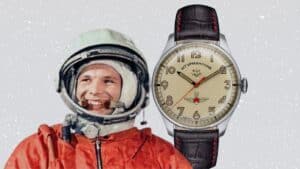
 But in all the fanfare, something curious was missing. The tools that carried him into orbit—the Vostok 1 spacecraft, his orange pressure suit, and even the watch strapped to his wrist—were absent from the story. The Soviet Union celebrated the man, but the machines were silenced. They were classified as state secrets, guarded as tightly as any missile technology. And so, while the world saw Gagarin beaming from open cars and podiums, what ticked quietly on his wrist went completely unmentioned.
That watch was the Sturmanskie, a simple, no-nonsense pilot’s watch produced for the Soviet Air Force. It was never designed to be a marketing tool or a luxury statement. It had no brand campaign, no glossy ads, no fancy export. It was issued to military flyers like Gagarin, who wore it as part of his uniform. Yet, by circumstance, it became the first watch in space—a fact the public wouldn’t know for decades.
This silence was deliberate. In the Soviet worldview, the hero was the story. Gagarin was the living symbol of achievement, proof of national strength and human courage. By contrast, the technology that carried him—whether the capsule, the rocket, or his watch—was not for display but for protection. It was guarded, hidden from foreign eyes, and omitted from parades and posters. The USSR wasn’t interested in turning objects into icons. It was interested in turning people into legends.
Elsewhere, the narrative unfolded differently. When American astronauts took flight, their rockets and capsules became household names. When Neil Armstrong walked on the Moon in 1969, the world remembered not only his words but also the machines that carried him there—the Saturn V rocket, the Apollo lander, even the Omega Speedmaster on his wrist. NASA invited the world to see the technology as well as the men, and companies like Omega turned that visibility into powerful marketing—securing the Speedmaster’s place in history as the Moonwatch.
That’s what makes the Sturmanskie so fascinating in hindsight. While the Omega Speedmaster was elevated to legend, Gagarin’s Sturmanskie remained anonymous. It ticked faithfully through the first human spaceflight, then faded into obscurity, unknown outside the Soviet bloc. Only after the Cold War ended, when archives opened and stories resurfaced, did the world learn that the first watch in space wasn’t Swiss at all—it was Soviet.
Today, the Sturmanskie is remembered as the first watch in space, while the Moonwatch holds its own legendary place on the Moon—two iconic timepieces born from different worlds.