
B.R.M. watches are not exactly wallflowers. The French brand makes timepieces that look like they drove straight off a Formula 1 grid and landed on your wrist. We’re talking oversize titanium cases, carbon fiber accents, chunky chronograph pushers, and rubber straps that mean business. If a Rolex Submariner is a navy officer in crisp uniform, a B.R.M. is the guy who shows up to a gala in a racing suit, and somehow it works.
That bold design philosophy is what draws collectors to the brand. It’s also what makes these watches prone to specific kinds of wear over time. The very features that make B.R.M. watches so visually arresting are the same ones creating stress points that a slim dress watch simply doesn’t have to deal with.
Big cases, active pushers, technical coatings, and heavy rubber straps all have quirks you should know about, especially if you want your watch to stay looking the way it did when it arrived in the box. Here’s where things can go sideways with your B.R.M. Racing watch:
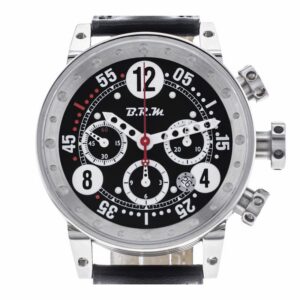
Crown and Pusher Wear
The crown and chronograph pushers on a B.R.M. watch are functional components, not decorative ones. On models designed with an active motorsport aesthetic, the pushers are large, exposed, and built so they can be operated easily with gloved hands and adrenaline-drenched nerves.
Regular use wears the internal gaskets inside each pusher over time. Those gaskets provide water resistance at the pusher stem. When they degrade, moisture can enter the case through the pusher channel.
The crown faces a similar fate. Screw-down crowns, which many B.R.M. models use, rely on threads and a gasket to create a seal when wound down. Routine winding and time-setting gradually wear both. You might not notice anything wrong until the crown doesn’t feel quite as firm as it used to. By then, the water resistance has likely already taken a hit.
Motorsport-inspired watches across the board share this vulnerability at the pusher stem, not just B.R.M. It’s a consistent finding in TAG Heuer watch repair, too. When we open those iconic racing chronographs, we find the same worn pusher gaskets as we do in B.R.M. service.
The fix is straightforward during a scheduled service: new gaskets and inspection of the stem and pusher tubes.
Gasket Degradation and Loss of Water Resistance
Every watch has gaskets, the small rubber seals sitting inside the case back, crown tube, and pushers. They don’t get much glory, but they’re doing important work. They degrade even when the watch is sitting in a drawer. Rubber compounds break down over time from contact with skin oils, temperature swings, cleaning products, and plain old age.
If you’re wearing your B.R.M. around water, on boat days, near the pool, or even just in humid summer heat, that breakdown speeds up. The sneaky part is that a watch can fail a water resistance test long before it shows any visible signs of trouble.
By the time you see fogging inside the crystal or notice the movement acting up, moisture has already been inside the case, doing damage. A pressure test after any service that opens the case, and periodically between services, is useful in detecting gasket and water-resistance issues before things get dire. Think of it as an annual physical for your watch’s water resistance.
Case Finish and PVD Wear
Titanium is tough, but it still scratches. The brushed finish on a titanium B.R.M. case will accumulate fine scuffs from everyday life: metal hardware, doorframes, gym equipment, that regrettable decision involving a golf cart and a parking pillar that your group chat still hasn’t forgotten.
Over time, those scratches soften and muddle the contrast between brushed and polished surfaces. It’s gradual enough that you might not notice until you compare photos from a couple years apart.
PVD coating, the colored surface treatment on many B.R.M. cases and bezels, has a harder road. It wears fastest at edges and corners, the spots that make contact with things most often.
Once the base metal starts showing through, the effect is hard to ignore. Carbon fiber and composite elements used on some models are even less forgiving. Unlike metal, they generally can’t be polished back to health. Chips or deep scratches often require component replacement rather than traditional refinishing. Catching wear early and keeping the finish clean goes a long way toward postponing that decision.
Strap and Lug Stress
B.R.M. watches are, to put it plainly, not small. A large, heavy case puts real mechanical load on the strap and the lug screws holding everything together.
Rubber and silicone straps are tough in most conditions, but they have weaknesses: UV exposure stiffens and cracks them over time, sunscreen and perfume accelerate surface breakdown, and repeated flexing at the buckle end eventually fatigues the material. If your strap looks dull, stiff, or has any cracking near the buckle, it’s on borrowed time.
Lug screws are easy to forget about until one goes loose. On an oversized watch, those screws carry more load than they would on a smaller piece, so they’re worth checking periodically, especially after outdoor or physically active use.
A strap that fails under tension can cause cosmetic damage to the lug area and case back, which is tough to fix cleanly. Replacing a tired strap before it gives out is much less expensive than dealing with the aftermath.
Movement Wear from Shock and Vibration
A racing-inspired watch often ends up in actual racing environments. Track days, paddock wear, and high-vibration settings are basically part of the B.R.M. brand identity. The problem is that mechanical movements don’t love sustained vibration.
Sustained vibration can accelerate wear on components like the automatic rotor bearing. The screws that secure internal movement components can gradually loosen. High-impact events like a dropped watch or a hard knock can knock regulation components out of place or affect balance wheel performance, even on a watch built for tough conditions.
The result can be a movement that runs fine lying flat but drifts noticeably when worn. It’s the kind of thing that’s easy to attribute to vague “watch stuff” until the discrepancy becomes impossible to ignore.
Regular service intervals and professional watch repair when required can help catch movement wear before it compounds into more extensive and costly damage.
Keeping It Race-Ready
B.R.M. watches are purpose-built to make an impression, and, like any finely tuned machine, keeping them in shape takes a bit of attention. The wear patterns above aren’t flaws in the design. They’re the natural result of building a watch with big pushers, bold finishes, heavy cases, and technical materials. The tradeoff is worth it for most owners. The watch looks like nothing else on the market.
Staying ahead of wear means regular inspection, periodic pressure testing, and professional service or repair on a reasonable schedule. Most issues caught early are straightforward to address. The ones caught late are the expensive ones.