
Citizen Eco-Drive is, at its heart, the story of Tsuyoshi Hanzawa—a soft-spoken Citizen engineer who, in the late 1970s, became obsessed with one simple, audacious idea: a watch should never die. While most of the industry dismissed solar technology as clunky or unattractive, Hanzawa imagined a movement powered quietly and endlessly by light itself. He spent years trying to crack the one problem no one else could solve: how to hide solar panels beneath a beautiful, normal-looking dial without compromising design.
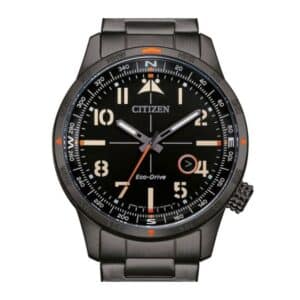 His breakthrough came when he discovered the dial could be made just translucent enough—microscopic pores, special pigments, precisely tuned color density—to let light pass through invisibly. When those photons slip through the dial, they strike a wafer-thin photovoltaic cell that converts them into electricity. The current then flows into a regulator that smooths the charge, prevents overloading, and channels the energy into what Citizen refers to not as a battery but a capacitor. Citizen uses this term because the storage unit behaves differently from a disposable battery: it’s a rechargeable lithium-ion energy reservoir engineered for constant charge–discharge cycles, designed to take in light daily, release power steadily, and repeat this process for decades.
Once charged, the capacitor feeds an ultra-efficient quartz movement built to sip electricity. Eco-Drive movements use low-friction gears, slimmed-down circuitry, and intelligent sleep modes that pause the hands in darkness while the internal quartz oscillator keeps perfect time, snapping the hands back to the correct position the moment light returns. The whole system is so sensitive that even faint ambient light—a hallway bulb, a cloudy sky, an office lamp across the room—keeps it alive, and a full charge can last months or even years without another photon.
But the capacitor has one vulnerability: if an Eco-Drive is starved of light for extremely long periods, the voltage can drop below its safe zone. When that happens, the chemical balance inside the capacitor becomes stressed, slowly reducing its ability to hold a charge. This is why deeply depleted Eco-Drive watches sometimes need capacitor replacements—not because the technology is fragile, but because it’s built to live on light, not long-term darkness.
The deeper you explore Eco-Drive’s inner workings, the more it feels like a tiny living ecosystem: the dial drinks in light, the photovoltaic cell transforms it, the regulator tames it, the capacitor preserves it, and the movement spends it with monk-like restraint. Everything works in quiet harmony inside a watch that never asks for a battery change—only to be near the light that powers life itself. And through it all, Hanzawa’s dream still pulses in every Eco-Drive: a watch that keeps time faithfully, endlessly, and almost magically.