
If you want to understand why a Panerai watch looks the way it does, skip the boutique and head straight to the history books. Specifically, the parts about elite Italian combat divers sneaking through enemy harbors in the dead of night during World War II. That’s where this whole story starts, making it a much better origin story than “a Swiss guy thought big watches were trendy.”
These watches weren’t built to sit in a display case. They were built to survive. That’s obvious the moment you start learning the history. It’s also why anyone who owns one, from collectors to folks just looking into Panerai watch repair, tends to end up a little obsessed with the backstory.
A Watchmaker, a Navy, and a Partnership That Changed Everything
Panerai got its start in Florence in 1860, founded by Giovanni Panerai. The original shop sat on the Ponte alle Grazie and served as both a watchmaking school and a retail operation. Early on, the company locked in a relationship with the Italian Navy as an official supplier of precision instruments and navigational gear. Think of it less like a watch brand and more like the navy’s favorite nerd with a workshop full of gadgets.
By the early 20th century, Panerai had outgrown retail and was deep into developing military equipment. To get the mechanical guts for their instruments, they partnered with Swiss movement manufacturers, most notably Rolex.
Switzerland handled the movements. Panerai handled the cases, the dials, the luminous compounds, and the engineering required to make everything clearly usable when the stakes were high. That partnership lasted for decades, and if you dig into vintage Panerai calibers today, you’ll find DNA that traces back to Rolex movements from the same era. Collectors absolutely geek out over this, and understandably so.
The transition from instrument supplier to watch producer happened gradually, driven by a specific and demanding new requirement: combat diving. When that requirement arrived, Panerai was already the navy’s most trusted source for precision timekeeping instruments.
Italy’s Underwater Special Forces
The Italian Navy developed one of the most impressive underwater combat units of World War II. The Decima Flottiglia MAS, also known as the Tenth Flotilla, trained divers to ride manned torpedoes, swim beneath enemy ships, and attach limpet mines to the hulls in complete silence. These weren’t guys doing laps at the local pool. These were elite operators conducting some of the most dangerous missions of the war, and they needed equipment to match.
The timekeeping requirements were critical. A mission timed incorrectly could result in surfacing at the wrong moment, missing a rendezvous, or detonating a charge at the wrong time. For these underwater operators, a watch wasn’t a status symbol. It was operational equipment, as essential as the torpedo or the wetsuit.
Standard watches of the era failed on almost every count. The cases were too small to read underwater in low visibility and limited light. The luminous treatments weren’t bright enough for sustained darkness at depth. Water resistance ratings didn’t account for the kind of sustained pressure these divers were dealing with. And the winding crowns on conventional watches were a liability: any intrusion point that could let water in at depth was a failure waiting to happen.
Panerai was contracted to take existing watchmaking components, most notably from Rolex, and turn them into purpose-built instruments for military use. The result was the Radiomir.
The Design That Answered a Brief, Not a Mood Board
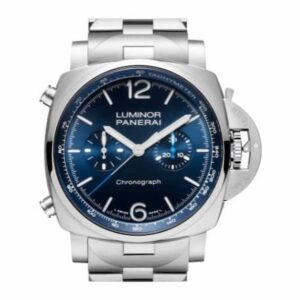
The Radiomir, introduced in the late 1930s, looked the way it looked because it had to. Nothing on it was decorative. The case measured about 47 millimeters across because readability under pressure wasn’t optional. The dial was stripped down to bold Arabic numerals and wide hands so a diver could register the time with one glance through a mask. The cushion shape kept the watch stable on the wrist over a wetsuit instead of spinning around every time the diver moved.
The luminous compound used on the early dials was radium-based, which is how the watch got the name “Radiomir.” The glow was intense enough to read in complete darkness at significant depth.
The use of radium was eventually discontinued as its hazards became better understood. Formulations shifted to tritium and, eventually, to the proprietary Super-LumiNova compounds Panerai uses today. But the core approach of coating every numeral and every hand with a highly legible luminous material has never changed. It’s still the whole point.
Water resistance was engineered from the ground up. Early Radiomir models relied on robust case construction and gasket sealing to withstand underwater use. Later Panerai designs introduced more advanced crown protection systems, including the now-famous crown bridge in the Luminor line.
That detail, a small but deliberate deviation from standard watch design, became one of the most instantly recognizable signatures of every Panerai built since. It’s a little like how you can spot a Jeep Wrangler by its round headlights from half a mile away: functional origin, permanent identity.
From Classified Contract to Cult Classic
After the war, the Italian Navy continued using Panerai watches with the same exclusivity that had defined the wartime relationship. The watches weren’t sold commercially. Production was small. The pieces that existed were either in active service or sitting in military inventory somewhere. They were not available at the corner watchmaker.
Panerai didn’t start selling watches to the public until 1993. By then, a small community of collectors had already been tracking down military examples through veterans, estate sales, and the occasional documented piece surfacing at auction.
That scarcity created intense interest. Buyers understood they were handling objects with a traceable chain of custody back to an active military program, and that context shaped what people were willing to pay. These weren’t antiques in the generic sense. They were artifacts.
The Richemont Group acquired Panerai in 1997 and provided the infrastructure for international expansion. But through all the growth, distribution deals, and boutique openings, the design vocabulary the military had specified remained fundamentally intact.
The cases stayed large. The dials stayed clean. The crown design evolved over time, but the overall silhouette that the military era established remained fundamentally intact. New materials, new movements, and new complications came along over the years, but they were all built onto a silhouette that hasn’t changed significantly since the late 1930s.
The Spec Sheet That Became a Style Icon
Modern Panerai releases still read like they were designed by someone who needed to get the time right or lose the mission. The proportions reference the Radiomir. The luminous treatment is still a core feature of every model. The crown protection system is more sophisticated than the one the Tenth Flotilla was issued, but the placement follows the same reasoning.
That clarity of purpose is unusual in the luxury watch world, where complications and ornamentation often exist to justify the price tag. Panerai’s position is more specific and more interesting. The design was tested under conditions where failure had real consequences, and it didn’t fail. That’s the whole pitch. It’s not marketing language dressed up as heritage. It’s the actual reason the watch looks the way it does.
So the next time someone asks why Panerai watches are so big, why the crown is in a slightly odd spot, or why the dial is so spare when other luxury brands are stacking complications like a game of horological Tetris, the answer is simple. A group of Italian frogmen needed to know the time in total darkness at the bottom of a harbor, and nobody was going to accept a watch that couldn’t handle the job. That same obsession with function is why professional watch repair matters for these pieces. They were built to perform, and they deserve to be kept that way.