Before the railroads arrived, American towns kept time by the sky. Noon was the moment the sun reached its highest point above a specific patch of ground, and that calculation shifted by four minutes for every degree of longitude you traveled. The result was a continent of hundreds of separate local times running simultaneously. For most of American history, this created no meaningful problems. A farmer in Ohio had no pressing reason to know whether his clock matched a merchant’s clock in Kentucky. Time was local because life was local.
Then the trains started running, and everything that had been a curiosity became a crisis.

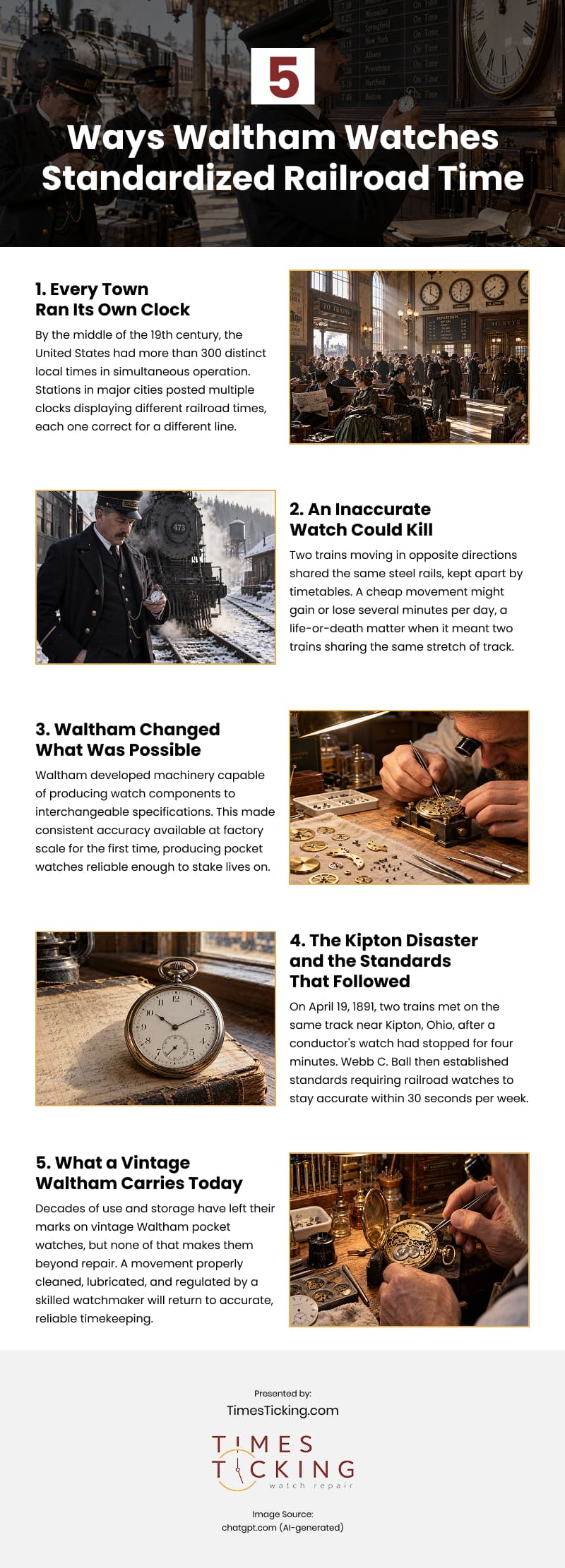
Every Town Ran Its Own Clock
By the middle of the 19th century, the United States had more than 300 distinct local times in simultaneous operation. Boston ran 16 minutes ahead of New York. Philadelphia sat five minutes ahead of Baltimore. And poor Pittsburgh. That city’s railroads operated on six different time standards at once.
For travelers arriving at a junction between two railroad lines, the resulting confusion could mean missing a connection. For trains moving at speed on shared track, it meant something far more serious than time lost waiting for the next train.
Railroad companies initially managed the problem by publishing their own schedules based on the time at their home city. A passenger trying to navigate a major transfer station had to know not only the departure time but also which railroad’s version of time applied to the train in question. Stations in major cities posted multiple clocks displaying different railroad times simultaneously, each one correct for a different line. Multiple clocks, multiple answers, and only one of them mattered to the train you were about to miss.
The railroad companies recognized the danger early. By the 1850s, several lines had issued pocket watches to conductors as required equipment. The logic was straightforward: a conductor without a reliable timepiece was operating blind. What the industry hadn’t yet resolved was how accurate that timepiece needed to be, who would verify it, and what standards it had to meet to be trusted with human lives.
An Inaccurate Watch Could Kill
Most single-track railroads in the 19th century operated on a system of temporal separation. Two trains moving in opposite directions shared the same steel rails, kept apart by timetables that assigned each train its place on the track at each moment in the schedule. The system worked when both conductors knew precisely what time it was. When one conductor’s watch ran slow, his train was occupying track that the schedule had already promised to someone else.
The watches issued to conductors in the early railroad era weren’t precision instruments. Pocket watches of that period varied in quality from the genuinely reliable to the genuinely dangerous. A cheap movement might gain or lose several minutes per day, and the difference compounded over a long run. That sounds like just a minor annoyance, but it was a life-or-death matter when it meant ensuring two trains didn’t share the same stretch of track.
Temperature change made the timekeeping situation even worse. The metal in a balance spring expands and contracts with heat and cold, shifting the rate of the oscillation that drives the entire timekeeping mechanism. A watch that performed acceptably in the warmth of a depot waiting room might run differently in the unheated cab of an engine crossing the mountains in January.
For a farmer or merchant, a few minutes of variation over the course of a week was an inconvenience, if it was noticed at all. For a conductor running a passenger train on a single-track line, it was the margin between a safe run and a collision.
Waltham Changed What Was Possible
The company that eventually became the American Waltham Watch Company moved into its new factory in Waltham, Massachusetts, in 1854. They approached watch manufacturing in a way the industry hadn’t seriously pursued before.
The traditional method produced movements one at a time, each hand-fitted by a skilled craftsman working components into alignment through individual judgment and patient adjustment. Quality was achievable this way, but it was also inconsistent. Every watch was, in some sense, a unique object, shaped by the particular hands and tools that assembled it.
Aaron Dennison, the machinist who co-founded the company, and his partners pursued a different model. They developed machinery capable of producing watch components to interchangeable specifications, ground to tolerances tight enough that parts from one movement could be correctly seated in another.
This “American System” of manufacture, which Waltham helped develop and refine, made consistent accuracy available at factory scale for the first time in the industry.
The implications were significant. A factory producing interchangeable parts could inspect each component against a known standard, catch deviations before assembly, and deliver finished watches that fell within a predictable range of accuracy. As Waltham’s machinery improved and tolerances tightened through the 1860s and 1870s, that range narrowed further.
By the later years of the century, the company was producing pocket watches accurate enough to function as navigational instruments: reliable enough for a man to stake a schedule on, and ultimately reliable enough to stake lives on.
The Kipton Disaster and the Standards That Followed
On April 19, 1891, two Lake Shore and Michigan Southern Railway trains met on the same track near Kipton, Ohio. The westbound passenger train was supposed to pull onto a siding and let the eastbound fast mail pass. It should have made the siding in time.
By the conductor’s watch, he was holding exactly to schedule. What the conductor didn’t know was that his watch had stopped for four minutes earlier that day and then restarted without his notice, leaving him that far behind without any indication that anything had gone wrong.
The fast mail express, running on its own time, came around a curve expecting clear track and found the passenger train directly in its path. Several people died in the collision, most of them postal clerks riding the mail cars.
The railroad industry responded by commissioning Webb C. Ball, a Cleveland jeweler who had been supplying watches to railroad workers, to establish formal standards for railroad timepieces. The requirements Ball codified were precise and non-negotiable, precise enough that his name still means something in the watch world.
Ball went on to found his own watch company, the Webb C. Ball Watch Company, which sourced movements from manufacturers like Waltham and held them to that exact standard. Bringing a piece in for Waltham or Ball watch repair honors the same standard: preserving and reviving watches built to survive a schedule that lives depended on.
A railroad-grade watch had to maintain accuracy to within 30 seconds per week. It had to incorporate a lever-set mechanism that required deliberate effort to advance the hands, preventing the accidental time changes that had contributed to past accidents. Dials had to be open-face rather than hunter-case, with the crown at the 12 position to prevent the watch from being misread under the dim, uneven light of an engine cab.
Waltham’s movements were built to meet and exceed these standards. The Vanguard, one of the company’s most respected railroad calibers, carried 21 jewels, a temperature-compensated balance wheel designed to hold accuracy across the range of conditions a working conductor encountered, and adjustment fine enough that most pocket watches never received anything close to it. Waltham built these calibers as precision instruments, held to a specification that acknowledged the direct relationship between accuracy and survival.
What a Vintage Waltham Carries Today
The vintage Waltham pocket watches that come in for service today carry that history in a literal sense. A Vanguard from the turn of the 20th century was inspected against standards more demanding than anything the public required, adjusted by skilled watchmakers who understood exactly what margin of error was permissible, and issued to men for whom the watch was a professional tool as much as a personal possession.
Decades of use and storage have left their marks on these precision tools. Lubricants applied at the last service have dried into residue or migrated away from the surfaces they were meant to protect. Pivots that cycled through millions of oscillations of the balance wheel carry the evidence of that work. Mainsprings have relaxed. Some movements have spent years in drawers, which creates its own set of problems.
None of that makes a vintage Waltham beyond repair. It makes Waltham watch repair a job that rewards the same attention the original manufacturers brought to the work.
A movement properly cleaned, lubricated, and regulated by a skilled watchmaker who understands what these calibers were designed to do will return to accurate, reliable timekeeping. The standards Waltham built to were stringent enough that the movements remain serviceable well over a century later, provided they’re treated with the care they were always meant to receive.
Video

Infographic