
Watch and Clock Repair Blog
You picked up a watch and the family member who gave it to you or person running the estate sale told you it was a Seth Thomas. But there’s nothing on it that actually says so. No name on the dial. No stamp on the case back. Just a watch everyone swears is a Seth Thomas, and not much proof to back that up.
That experience is more common with Seth Thomas than with most other American watchmakers. Once you know where to look, though, an unmarked Seth Thomas usually still tells its own story. You just have to read it in different places than the dial.
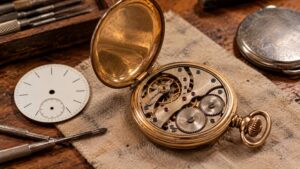
Why Seth Thomas So Often Skipped the Signature
Seth Thomas built its reputation on clocks first, and that history shaped how the company approached watches later on. As demand grew for affordable, reliable timepieces, manufacturers across the industry leaned on mass production and shared components to keep prices in check. A stamped dial or case took extra time and material. Putting their name on it cost money, but buyers weren’t usually willing to pay more for those markings, so they didn’t make commercial sense.
Many watches from this era also moved through catalogs and jewelers, or even general stores. These sellers stocked lightly branded or private-label movements. A retailer could sell a Seth Thomas movement inside a case with no maker’s mark anywhere, or pair it with a generic case that never carried the company name to begin with.
None of this makes the watch less genuine. It just means an accountant in 1900 was thinking about margins, not about you squinting at a case back a century later.
This pattern wasn’t unique to Seth Thomas, but the company’s scale made it common enough that a real share of surviving pieces show up with a bare dial and a plain case back. A watch like that puts you in familiar territory, not a dead end.
The Movement Talks Even When the Dial Won’t
When the outside of a watch isn’t talking, the movement usually will.
Open the case back (carefully!) and check the plate, the bridge, or the area around the balance wheel. That’s the small wheel that regulates the watch’s beat. Seth Thomas movements were often engraved with the company name, a model or grade designation, or a jewel count, even on pieces with a blank dial and case.
A stuck case back or an unfamiliar latch deserves patience, not force. Avoid prying at an old case with the wrong tool. That tends to leave scratches or a damaged gasket that never seals properly again. That kind of damage can turn an interesting identification project into a repair bill.
Seth Thomas watch repair specialists open these cases every day and know which era calls for a gentle push, a screw-down twist, or a proper case knife. So if you don’t want to risk damage during your name hunt, consider sending the timepiece off to a professional.
Even a partial engraving is useful. A grade number or jewel count alone can narrow a watch down to a specific production run once it’s compared against known Seth Thomas references, even without a full serial number to work from.
Some movements really do come up blank, with no engraving of any kind beyond a serial number, or occasionally not even that. That doesn’t necessarily mean you’re out of luck. When that happens, the movement’s layout still helps.
Bridge shape, the arrangement of the jewels, and the style of the balance cock are consistent enough within a given production run that a watchmaker familiar with Seth Thomas references can often match a bare movement to a known grade by sight alone. This is one of the few identification steps that benefits from experience over guesswork, since two visually similar movements from different makers can look nearly identical to an untrained eye.
An Unmarked Case Still Has Plenty to Say
The case is a separate object from the movement, and vintage watchmakers didn’t always keep the two paired for life. Seth Thomas movements have turned up in cases made by other manufacturers, and cases originally built for Seth Thomas movements have occasionally ended up housing a different maker’s parts after decades of repairs and swaps.
Even so, the case still holds clues. Material, hinge style, and case-back construction shifted across different periods of production. Those details narrow down when a case was made, even when they can’t confirm who made the movement inside it. A screw-back case in nickel silver points to a different era than a snap-back case in gold-filled brass, for example.
Check for anything stamped in the metal beyond a company name: material marks, patent dates, or a case maker’s initials. Marks like these come from the case manufacturer rather than Seth Thomas, but they still date the piece and rule out possibilities.
A Serial Number Is a Clue, Not a Verdict
A serial number, when one exists, is one of the more reliable clues you will find. This is closer to a fingerprint than a name tag: specific, but it still needs someone who knows how to read it.
It usually sits on the movement rather than the case, and it can sometimes be compared against known production patterns to estimate roughly when a specific movement left the factory.
A serial number narrows a range of production years. It doesn’t explain why a dial or case shipped blank, and it doesn’t confirm the case was original to that movement. Treat a serial number as one data point among several rather than the final word. Paired with what the movement and case already told you, the picture usually gets clear enough to make a confident call.
Occasionally, a number shows up on the inside of the case back instead of, or alongside, the movement. That number usually belongs to the case maker’s own production run rather than Seth Thomas, and mixing the two up is a common mistake.
When a case number and a movement number tell two different stories about age, trust the movement number for dating the watch itself. Treat the case number as a note about the case’s separate history instead.
A Blank Dial Still Suggests the Era
Beyond engravings and stampings, the watch’s overall design says something, too. Dial layout, hand shape, crown style, and crystal type all shifted over the decades Seth Thomas was in operation.
A plain porcelain dial paired with blued steel hands reads differently than a printed dial with luminous markers, even before the movement enters the picture. This is like a flip phone in a movie scene: you immediately know the era based on the hardware.
A few style details worth checking:
- Dial material and printing style
- Hand shape and finish
- Crown and crystal type
- Case proportions and lug style (Lugs are the small tabs where the strap attaches.)
None of these cues confirms a maker on its own. Together, though, they begin to create a full picture. They place a watch inside a specific decade or production window, and that window either lines up with what the movement and case already told you, or it doesn’t, which is a clue in itself.
A mismatch isn’t automatically bad news. Watches often passed through more than one case or crystal over their working lives, so a replacement crystal or a later crown doesn’t undermine an otherwise consistent movement and case.
Use style cues to build a timeline, then compare that timeline against the other evidence to see whether the pieces are telling a consistent story.
Unmarked Doesn’t Mean Unknown
An unmarked Seth Thomas watch usually has a straightforward explanation. It left the factory during years when branding took a back seat to volume, and its identity ended up written on the inside instead of the outside.
Read that identity carefully, movement by movement and case by case. That work tells you what you actually have before you decide whether the watch is worth restoring, wearing, or passing down. A found or inherited watch you aren’t confident opening yourself is exactly the kind of case worth sending to someone who does this daily. Once they’re inside, they can also evaluate the condition and give your Seth Thomas the professional watch repair it deserves.
When you know what you’re holding, you can decide whether it deserves a full restoration or a simple cleaning and a new lease on your wrist.