If you know Doxa, you almost certainly know the SUB. That’s fair. The SUB earned its reputation honestly and still dominates most conversations about the brand. It’s the “Bohemian Rhapsody” of Doxa’s catalog: so well known that everything else kind of disappears behind it.
But if that’s where your Doxa knowledge stops, you’re missing a much stranger and more interesting chapter of the brand’s history.
Doxa made some genuinely unusual and wonderful watches over the decades, pieces that feel completely disconnected from the orange-dial diver image most people picture first. These lesser-known models open up a broader view of what Doxa was capable of during the mid-century period. They also offer the kind of hunt that makes vintage collecting rewarding in the first place.
If Queen fans stopped at “Bohemian”, they’d miss out on “We are the Champions” and “Don’t Stop Me Now,” among other gems. And if your Doxa knowledge begins and ends with SUB, we hope that, by the time you finish reading this, you’ll be singing a different tune.

Why These Watches Flew Under the Radar
Anyone who’s gone deep on Doxa watch repair or restoration work quickly learns that a lot of these rarer references are surprisingly hard to find information on, let alone actual examples of.
Limited production runs, regional distribution, and the long shadow cast by the SUB all contributed to keeping certain models obscure. It’s a pattern that frequently appears in vintage collecting. One iconic model becomes the whole brand story, and everything else quietly disappears unless you’re very lucky or willing to hunt.
That obscurity is exactly what makes these watches worth chasing. When you find an unusual Doxa from the 1950s or 1960s, you’re often looking at something that sat outside the collector spotlight for decades. The scarcity is genuine, not manufactured. Many of these pieces were never common to begin with, so surviving examples in good condition are hard to come by.
Condition carries serious weight here. A rare reference with its original dial, hands, and unpolished case can be far more compelling than a more famous model that’s been overworked and rebuilt from mixed parts over the years.
The Doxa Grafic And The Quiet Power Of Simplicity
The Doxa Grafic is probably the most striking example of how different this brand could be when it wanted to. Where you might expect bold watch energy, the Grafic gives you something almost architectural. Minimalist, clean, and quietly confident, it’s the kind of watch that Bauhaus design students would have put on a mood board.
What makes it stick in your memory is restraint. The dial doesn’t try too hard. The case proportions feel intentional rather than showy. It looks like it was designed by someone who spent a lot of time thinking about negative space. That kind of simplicity ages remarkably well, which is why these watches still feel contemporary, rather than dated.
For collectors, the Grafic also represents a side of Doxa that most people never associate with the brand at all. It proves they could handle dress and design-forward watchmaking with the same confidence they later brought to dive tools.
The T. Graph Should Have Been Famous
If there’s one obscure Doxa that’s slowly getting the recognition it deserves, it’s the T. Graph. This early dive chronograph has the kind of specification list that’s usually attached to bigger, more expensive names. It has serious presence, genuine rarity, and 1960s sport-watch energy that collectors find almost impossible to resist.
The T. Graph has that quality of feeling like it should have been more famous than it was. The case has substantial, balanced weight. The chronograph layout looks purposeful rather than decorative. The whole package carries that mid-century tool-watch confidence without the mid-century tool-watch price tag that’s usually attached to better-known references.
That gap between quality and recognition creates real opportunity. You’re not buying the obvious answer. You’re buying the watch that rewards actually knowing your stuff.
Anti-Magnetique, Chronometre, And Other Quiet Achievers
Some of the most interesting rare Doxa watches are the ones that don’t announce themselves immediately. The Doxa Anti-Magnetique is a good example of that. It belongs to that earlier era of practical tool watches, where engineering credibility mattered more than marketing. There’s no flashy backstory attached to it, just a well-made watch with real historical weight and a design language rooted in utility.
The Chronometre line takes a different direction entirely. These models lean toward precision and refinement, dress-watch seriousness in a market currently obsessed with oversized cases and aggressive bezels. A well-preserved Doxa Chronometre is the kind of watch that rewards close attention. It grows on you rather than grabbing you immediately, which is either a flaw or a feature depending on your collecting style.
Worth mentioning too are the dual-crown compressor case divers from Doxa’s 1960s lineup. They get overlooked almost entirely because collectors tend to funnel their attention straight toward SUB references. But these models show how broadly Doxa was working within the dive category before one design became the whole conversation.
Why Restoration Requires Restraint
Tracking one of these watches down is only half the battle. Once you have it, restoration becomes part of the story, and that’s where things can go sideways fast. A professional watch repair specialist with vintage experience isn’t a luxury here; it’s genuinely necessary if you want to protect what makes the watch interesting and valuable in the first place.
Heavy polishing erases sharp case lines that control the watch’s character. A redial strips out the original personality and replaces it with something generic. Wrong replacement parts might get the watch running again, but pull it further from what it originally was.
Thoughtful restoration means keeping the watch stable, clean, and wearable without scrubbing away its history. Function matters, but so does honesty. The best outcomes preserve both.
Why These Forgotten Doxas Deserve Your Attention
Rare vintage Doxa watches give you something hard to find: a chance to collect outside the expected script while staying within a brand that has real depth and credibility. You get unusual design, historical richness, and the specific satisfaction of finding something most people walked right past.
If you’re willing to look beyond the SUB, there’s a much broader Doxa story waiting. It includes minimalist design experiments, early technical ambition, refined dress pieces, and dive watches that never quite got their moment but absolutely earned one.
That’s where vintage collecting stops feeling like shopping and starts feeling like actual discovery. Look past the SUB, and you’ll soon be singing the praises of the entire Doxa catalog.
Video

Infographic
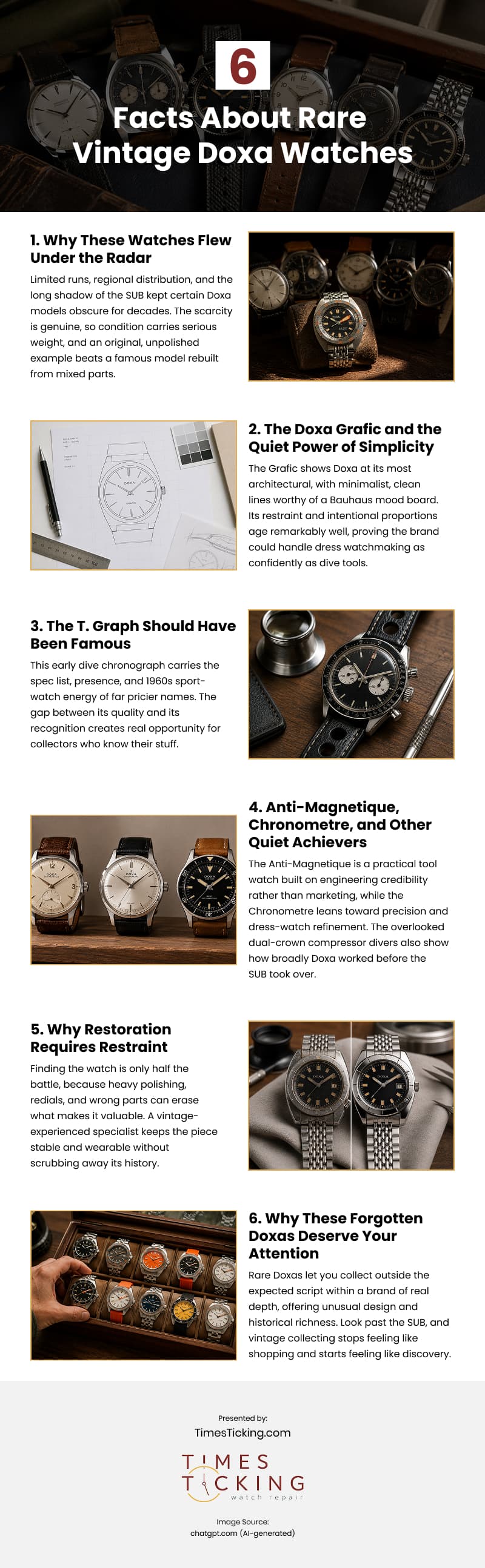
Doxa has produced many unique watches throughout its history, and several lesser‑known models have stayed under the radar due to limited production, regional availability, and the iconic SUB line overshadowing them. This infographic shares six facts about rare vintage Doxa watches.