
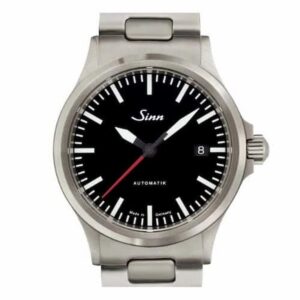
You’ve had the Sinn for years. Pilot’s watch, tool watch, the kind of thing that doesn’t just sit in a drawer. Then one day it stops, and the report from a local repair shop lands like a horological left-swipe: discontinued movement, parts unavailable, nothing in the catalog. It’s tempting to take that as a permanent verdict. In most cases, it isn’t. It’s often just a sign you’re working with the wrong professional watch repair shop.
Older Sinn models built around movements like the Lemania 5100 or early ETA calibers occupy a specific position in watch history. Durable, reliable, well-regarded by serious collectors, and now increasingly dependent on expertise rather than manufacturer support. That shift changes what repair looks like, but it doesn’t make repair impossible.
What “Discontinued” Actually Means for a Watch Movement
When a movement manufacturer discontinues a caliber, they stop producing parts and selling them through official channels. The movement itself doesn’t vanish from the world, and neither does the supply of existing components. The parts simply come from a different place, and it may take more effort to track them down.
For movements like the Lemania 5100, discontinued simply means the manufacturer no longer supports that component. These calibers were produced by the thousands over many years and found their way into watches from multiple brands. Watchmaker inventories, parts brokers, and donor watches still hold genuine components. Finding them takes considerably more effort than pulling from a current catalog, but skilled watchmakers have been doing exactly this kind of sourcing for decades.
Early ETA calibers create a slightly different situation. ETA began phasing out movement sales to third-party brands after a 2013 settlement, a process that didn’t finish until the practice ended completely in 2020. That fully cut off the official supply chain for a generation of well-built watches.
That phase-out affects routine maintenance, not just emergency repairs. Gaskets wear out. Oils need replacing every few years. Tiny components eventually fail. For watches that depend on parts no longer in production, even standard servicing requires a watchmaker comfortable working outside the official supply system. Most general repair shops aren’t set up for that. Specialists are.
The Lemania 5100 and Early ETA Calibers: Where Things Stand
The Lemania 5100 was a chronograph built for durability over elegance. It runs on a simpler cam-based system rather than the traditional column-wheel system most high-end calibers use to control the stopwatch functions.
This movement powered watches worn by military pilots, found its way into motorsport timekeeping, and wound up at home inside Sinn’s 142, where the caliber’s hard-use philosophy matched the watch’s purpose exactly. Collectors who prioritize function over prestige have followed the 142 for that reason.
One practical advantage the 5100 carries is its adoption across multiple manufacturers. Heuer built some of its own racing chronographs around the same caliber, so anyone chasing Heuer chronograph vintage watch repair today is drawing from the same parts network as a Sinn 142 owner.
A movement shared by several brands generates a larger secondary market. More donor watches exist in circulation. More technicians have worked on the caliber across its decades of service life. More components have cycled through repair benches around the world. A watchmaker who encounters a 5100 today brings all of that accumulated service history to the job. It’s a caliber that professionals have come to understand in depth, even as the manufacturer’s support has disappeared.
Early ETA calibers like the 7750 and 2824-2 follow the same logic on a larger scale. These movements powered tens of thousands of watches from dozens of brands over several decades. The secondary market is extensive. The watchmaker community familiar with these calibers is large. The supply of donor movements, NOS parts, and service knowledge is deeper than it is for many calibers still nominally in production.
Where both movements get difficult is specific worn components. The more fragile a part and the further it sits from production, the thinner the available supply. Chronograph levers, certain jewels, worn pivots, and delicate keyless works components (the crown-and-stem mechanism that winds and sets the watch) become genuinely hard to source once enough time has passed. That’s the real challenge with a discontinued caliber, and it’s where the watchmaker’s experience really shines.
Professional Watch Repair Sourcing for a Discontinued Caliber
Parts for out-of-production movements come from three distinct paths. Experienced watchmakers work through all of them depending on what the repair requires.
NOS
New old stock (NOS) parts still exist in the trade. These are original manufacturer components purchased by suppliers before production ended and held in inventory for exactly this kind of need. NOS parts are genuine, confirmed compatible, and often in better condition than anything pulled from a worn donor movement.
Availability is unpredictable and varies by caliber and component. Some parts remain reasonably accessible. Others have become rare enough that sourcing shifts to the second option.
Donors
Donor movements are the more common solution for hard-to-find pieces. Sourcing an entire spare movement from a non-running watch gives a watchmaker access to every component in that caliber. The donor watch might have stopped running for an unrelated reason, leaving the needed part intact and serviceable.
It takes care and precision to extract a functioning component from a broken movement, but the result is a genuine part that belongs in the caliber, not something improvised from outside it.
Compatible Parts
Compatible components from related calibers are a third option that applies in specific situations. Certain movements share enough design characteristics that a part from one can be adapted for use in another.
This isn’t guesswork. It requires thorough knowledge of both calibers, careful measurement to confirm tolerances, and judgment about whether the modification will hold up under normal use. When handled correctly, it extends repair options for movements whose own supply has dried up.
When Fabrication Becomes the Answer
At some point, sourcing runs out. For a component that no longer exists in inventory, donor watches, or related calibers, the remaining option is fabricating it from scratch.
A watchmaker producing a part by hand works from the original specifications of the movement, machining to tolerances that match what the manufacturer intended. The result fits the way the original did and functions the way the original was designed to function. Common candidates for fabrication include wear-prone levers, hand-wound crown components, and certain bridges or plates that rarely turn up in the secondary market.
The process requires precision equipment that most repair shops don’t own and the kind of caliber-specific knowledge that only comes from years spent working on the same movements. It’s slow, skilled work, and it has significant cost. For a watch with substantial collector value or significant personal history, that cost is often well worthwhile. For a basic quartz watch worth a few dollars on the secondary market, the math doesn’t work in the owner’s favor.
Sinn watches built around the Lemania 5100 or early ETA calibers tend to land on the right side of that calculation, alongside family heirlooms worth preserving. They were designed as instruments, chosen for performance, and built with the expectation that they’d be serviced for decades.
When a collector sends in one of these movements with a failed component that can no longer be sourced, fabrication keeps a watch alive that would otherwise stop permanently.
What to Look for in a Watchmaker for These Repairs
Not every repair shop is equipped to handle discontinued calibers, and the difference goes beyond equipment. It’s depth of knowledge about specific movements, access to sourcing networks in the vintage parts trade, and the capability to fabricate when sourcing doesn’t cover it.
When you’re looking for someone to work on a Sinn with a discontinued movement, a few things are worth asking about directly:
- Has the technician worked on that specific caliber before?
- How do they approach parts sourcing when a component isn’t in their current inventory?
- Do they have fabrication capability in-house or access to someone who does?
A shop that answers these questions specifically is a different situation from one that promises a general inspection and a vague “parts order.”
Watch repair for discontinued movements is a specialty. A second opinion from a specialist often changes the picture significantly, particularly when the first shop’s answer was simply that nothing could be done.
A Working Sinn Is Worth the Effort
A Sinn with a discontinued movement isn’t a watch destined for the scrap pile. With the right kind of attention, it can almost certainly be repaired.
Parts scarcity separates shops that rely on catalog orders from those that have developed the skills and networks to work without one. A watchmaker with deep experience in discontinued calibers changes what’s possible. You don’t need to accept an “unrepairable” verdict from a shop unfamiliar with the Lemania 5100 or early ETA movements.
You might be surprised how often the answer changes once someone who genuinely knows the caliber takes a look.