
Some watch mysteries begin when a collector opens a case back. Others start when a rare reference surfaces at auction. The Croton–Nivada Grenchen mystery begins with something far simpler: a name on the dial.
Or rather, two names.
Collectors have long noticed that vintage watches from the same company can be found marked “Nivada Grenchen,” “Croton Nivada Grenchen,” or sometimes simply “Croton.” At first glance, it doesn’t make much sense. Were these different companies? Different watches? Different markets? Did one brand acquire the other?
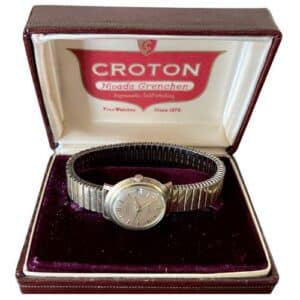 The deeper you dig, the stranger it becomes. Some of Nivada Grenchen’s most famous models—including chronographs, dive watches, and travel watches—appear under multiple names depending on where they were sold. To modern collectors, it can feel like a puzzle hidden in plain sight.
The truth reveals a fascinating chapter of watch history and a reminder that building a watch and selling a watch were often two very different businesses.
To understand why one watch could carry two names, we have to travel back to the middle of the twentieth century, when Swiss watchmaking was booming and America had become one of the most important watch markets in the world.
Swiss manufacturers were producing some of the finest timepieces on earth, but success in the United States wasn’t guaranteed. Designing and building a great watch was only half the battle. Getting that watch into jewelry stores across thousands of miles of American territory required distribution networks, advertising campaigns, retailer relationships, and a deep understanding of local markets.
That is where Croton entered the story.
 Croton was already an established name in the American watch business. Long before most consumers had ever heard of Nivada Grenchen, Croton had built relationships with retailers throughout the United States and had developed valuable brand recognition among American buyers.
Nivada Grenchen, meanwhile, was building a reputation in Switzerland for producing durable and innovative watches. Founded in Grenchen, Switzerland, the company became known for practical tool watches that appealed to divers, pilots, travelers, and sportsmen. Models such as the Chronomaster Aviator Sea Diver would eventually become some of the most recognizable watches of the era.
The challenge was simple.
Americans knew Croton.
Most Americans did not know Nivada Grenchen.
Rather than starting from scratch, the two companies developed a relationship that benefited both sides. Croton provided access to the American market, while Nivada Grenchen supplied Swiss-made watches that could compete with the best products coming out of Europe.
The result was a branding strategy that still confuses collectors decades later.
Many watches destined for the American market were sold under the combined name “Croton Nivada Grenchen.” In Europe and other international markets, the same watches were often sold simply as Nivada Grenchen. Depending on the period, the model, and the intended market, customers could encounter different branding on essentially the same watch.
From a modern perspective, this feels unusual.
Today, luxury brands guard their identities with extraordinary precision. Every logo, advertisement, and retail experience is carefully controlled. Consumers expect consistency across every market.
The watch industry of the 1950s and 1960s operated under different rules.
Back then, distributors often carried tremendous influence. Their job was not merely to transport products. They helped shape how those products were presented to customers. If attaching a trusted American name to a Swiss watch helped increase sales, it was considered smart business.
And it worked.
For an American customer walking into a jewelry store, the Croton name provided familiarity. The Nivada Grenchen name added Swiss prestige and manufacturing credibility. Together, they created a combination that appealed to both trust and aspiration.
What makes the story particularly interesting is that the strategy was so successful it eventually created its own mystery.
Collectors looking back decades later see watches bearing different names and naturally begin searching for explanations. Some assume Croton owned Nivada Grenchen. Others believe Nivada Grenchen acquired Croton. Still others assume the brands merged at some point.
The reality is more nuanced.
Croton served as the American distributor and marketing partner, while Nivada Grenchen remained the Swiss manufacturer behind the watches. The relationship was genuine and significant, but it was not simply a matter of one company becoming the other.
In many ways, the confusion comes from the fact that modern collectors are studying the surviving products without seeing the business environment that originally created them.
The watches survived.
The advertisements survived.
The catalogs survived.
What largely disappeared were the distributors, sales representatives, and business arrangements operating behind the scenes.
Imagine discovering a movie poster decades after the film studio closed its doors. You can still understand the story being sold, but many of the decisions behind the marketing have been lost to time. The Croton–Nivada Grenchen relationship presents a similar challenge. The watches remain remarkably visible, while much of the commercial machinery that placed them on store shelves has faded into history.
Yet traces of that history still exist.
Collectors regularly encounter Chronomasters, Antarctic models, Depthmasters, and other Nivada Grenchen watches carrying Croton branding. These pieces serve as reminders of how international watchmaking operated during a period when distributors often played a larger role than modern enthusiasts realize.
They also remind us that watch history is not just about engineering.
It is about commerce.
It is about relationships.
It is about finding ways to connect products with customers.
Without Croton’s established American presence, many U.S. consumers might never have encountered Nivada Grenchen. Without Nivada Grenchen’s Swiss watchmaking expertise, Croton would not have had the same remarkable products to offer. Each company brought something valuable to the relationship, and together they helped introduce generations of Americans to Swiss watchmaking.
Ironically, the success of that partnership is precisely what created the confusion.
The closer the names appeared together, the more future collectors assumed they must be the same company. The stronger the branding became, the harder it became to separate the roles each played in the story.
That misunderstanding has endured for decades.
Even today, questions continue to appear on collector forums, auction listings, and watch communities asking why the same watch seems to have multiple identities. The answer lies not in the movement, the dial, or the case back, but in the business realities of a different era.
In the end, the Croton–Nivada Grenchen mystery is not really about two names on a watch.
It is about how watches traveled from Swiss workshops to American wrists.
One company built the watches.
The other helped build the market.
Together, they created a branding partnership so successful that generations later collectors are still trying to untangle it. The watches were designed to tell time, but their dual identity ended up telling a much larger story—one about international commerce, marketing, and the unlikely partnership that helped bring Swiss watchmaking to America.