
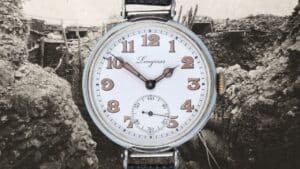
 At the dawn of the 20th century, a gentleman carried time in his pocket. Wristwatches were, quite frankly, considered effeminate—more suited for delicate women than for men of industry or war. But in the trenches of World War I, where every second could mean life or death, pocket watches proved maddeningly impractical. Imagine fumbling for a watch chain while crouched in mud, gas mask pressed to your face, hands shaking as artillery thundered overhead. Time needed to be immediate, accessible, visible in the dark. And so, soldiers began soldering crude wire lugs onto pocket watches, strapping them to their wrists with thick leather bands, often covered with protective grills or “shrapnel guards.” The trench watch was born not from fashion, but from survival.
And yet, there is style there, even if unintended. The broad numerals painted with radium that glowed faintly through the night. The onion-shaped crowns made to be gripped with gloved hands. The enamel dials, simple and functional, that now bear the soft cracks of age like laugh lines on an old face. The straps—heavy leather or canvas—that once smelled of sweat, earth, and gunpowder. These were not luxury goods; they were instruments. But in their stripped-down purpose, they became accidentally elegant, imbued with a kind of raw honesty.
As the war dragged on, watchmakers recognized the soldier’s need and responded. Longines, Omega, Zenith, Elgin, Waltham, and others began producing wristwatches specifically marketed to officers and men at the front. These weren’t usually official issue—most soldiers purchased them privately through outfitters, catalogs, or military suppliers—but they were designed with war in mind: luminous radium dials, sturdy cases with soldered wire lugs, and leather straps built for rough wear, sometimes fitted with shrapnel guards. What began as improvised conversions quickly evolved into purpose-built trench watches, bridging the gap between civilian timekeeping and the demands of modern warfare.
After the guns fell silent in 1918, trench watches came home. Many ended up tucked in drawers, forgotten keepsakes alongside medals and letters. Others were worn proudly by veterans who could never quite shed the habit of checking their wrist instead of their pocket. The cultural shift had taken root: men now wore wristwatches openly, and by the 1920s, the industry had fully pivoted to embrace them. Without the war, without the trenches, the wristwatch might never have become the masculine standard it is today.
To hold a trench watch now is to feel that transition in your hand. It’s delicate compared to modern pieces, but it thrums with history. Every nick on the case, every worn strap hole, tells of someone who relied on it not for vanity but for survival. There’s a poignancy in knowing that these humble timekeepers carried the heartbeat of soldiers through some of humanity’s darkest days. And perhaps that’s why collectors, historians, and romantics find them irresistible. They’re not just watches—they’re witnesses.
The trench watch is forgotten by many, overshadowed by the sleek Rolex Oysters and Omega Speedmasters that came later. But to forget it is to miss the turning point—the moment when time moved from the pocket to the wrist, when function bent tradition, and when necessity birthed something unexpectedly beautiful. It is, in its own quiet way, one of the most important inventions of the 20th century—not because of how it looked, but because of what it endured.
And maybe that’s what draws us to vintage watches in the first place. Not perfection, not polish, but stories. Stories etched into enamel dials, whispered in ticking movements, stitched into cracked leather. Stories like the trench watch, where practicality became poetry, and where time itself was rewritten on the wrist of history.