
Watch and Clock Repair Blog
The History of Corum
Corum begins not with quiet mastery, but with a quiet act of rebellion. In 1955, in La Chaux-de-Fonds, Corum was founded by Gaston Ries and his nephew René Bannwart, a watchmaker who looked at the polished, tradition-bound world of Swiss horology and saw not perfection—but repetition; while others honored the past by preserving it, Bannwart believed the future of watchmaking would belong to those willing to challenge it, to create timepieces that didn’t just measure hours, but sparked curiosity the moment they were seen.
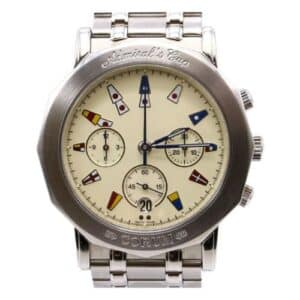 That belief quickly took shape. In 1960, Corum introduced the Admiral’s Cup, a watch inspired by international yacht racing, where the hour markers were replaced with maritime signal flags—each one part of a coded language used at sea; it wasn’t just a design choice, it was a shift in thinking, turning the dial into something that communicated identity and meaning, a watch that felt less like an instrument and more like a signal to those who understood it.
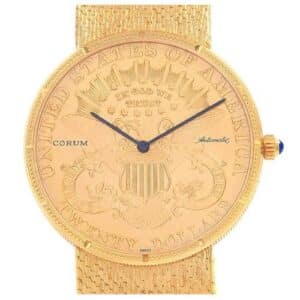 Then, in 1964, Corum did something few brands would dare attempt. It took genuine U.S. gold coins—most notably the $20 Double Eagle—and transformed them into watches, carefully opening the coin, integrating an ultra-thin Swiss mechanical movement—often ETA-based—and sealing it back together so that from the outside, it appeared almost untouched; the result was a piece that blurred the line between currency and craftsmanship, between object and artifact, and it quickly found its way onto the wrists of presidents and influential figures, not because it followed tradition, but because it broke from it so completely. Corum wasn’t just making watches—it was turning history into something you could wear, proving that time, quite literally, could be money.
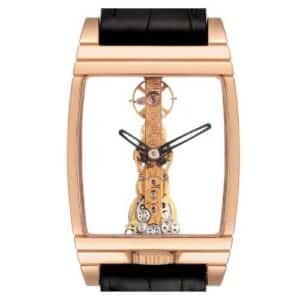 But Corum’s most defining moment came in 1980, with a watch that stopped people in their tracks. The Golden Bridge did not hide its movement beneath a dial—instead, it exposed it completely, a long, linear baguette movement stretching from end to end, developed with master watchmaker Vincent Calabrese, suspended inside a transparent case as if gravity itself had been reconsidered; there is a moment, when you first see a Golden Bridge in person, where your brain pauses—searching for the missing dial, expecting something familiar—and then it clicks: nothing is missing, everything is revealed, and in that instant, you’re no longer just reading time, you’re watching it exist. That was Corum’s gift—it didn’t just bridge mechanics and design, it changed how people saw the passage of time itself.
Yet even bold ideas must survive real-world pressures. The quartz crisis reshaped the Swiss watch industry, and Corum, like many others, faced the challenge of remaining relevant in a market that suddenly valued affordability and precision over artistry; the brand endured, but its next defining chapter came in 2000, when it was acquired by Severin Wunderman, an American entrepreneur known for building global luxury distribution networks. Wunderman didn’t simply maintain Corum—he repositioned it, expanding its international retail presence, strengthening partnerships in the United States and Asia, and amplifying its identity through bolder, more visible collections; flagship lines like the Admiral’s Cup grew in size and complexity with automatic chronographs, the Golden Bridge evolved into new variations, and Corum re-emerged as a brand that wasn’t just respected—but noticed again.
Following Wunderman’s passing in 2008, Corum entered a period of transition before being sold in 2013 to China Haidian Holdings (now Citychamp Watch & Jewellery Group) for approximately $140 million USD; the acquisition marked a broader shift in the luxury watch industry, where global investment began reshaping historically Swiss-owned brands, and under Citychamp, Corum retained its Swiss manufacturing while gaining expanded access to Asian markets, allowing it to continue producing distinctive timepieces while adapting to a rapidly changing global audience.
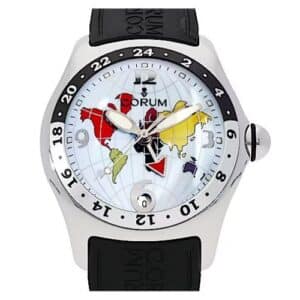 Even through these changes, Corum never lost its appetite for experimentation. In 2000, it introduced the Bubble watch, a piece defined by its dramatically domed sapphire crystal that magnifies and distorts the dial beneath it, creating an almost surreal viewing experience; powered by automatic Swiss movements—often ETA or Sellita-based calibers depending on the model—the Bubble wasn’t about subtlety, it was about perspective, reminding the wearer that even something as constant as time can look completely different depending on how you choose to see it.
Across its history, Corum has balanced reliability with invention, using proven Swiss automatic and manual-wind movements as a foundation while pushing design into territories few brands explore; whether it’s a coin turned into a timepiece, a movement stretched into a visible line, or a crystal that reshapes perception, the brand has consistently asked the same question in different forms: what else can a watch be?
Today, Corum stands not as a follower of tradition, but as a challenger of it—a brand that has spent decades refusing to tick in step with the rest of the industry; and that is why its story endures, not because it mastered time, but because it reimagined it, proving that the most compelling watches are not the ones that simply tell you the hour—but the ones that make you stop, look twice, and lose track of it entirely.