
Watch and Clock Repair Blog
In the watchmaking world, Switzerland had centuries of experience, Germany had precision engineering, and Japan had mastered mass production. Australia? Well, Australia had kangaroos, beaches, and two guys sitting at a bar who thought they could take on the watch industry. It sounded like the beginning of a bad joke. Instead, it became the beginning of Panzera.
In 2009, Andrew Herman and Roger Cooper were enjoying a few drinks at the Opera Bar overlooking Sydney Harbour and discussing their expensive obsession with watches. Both loved collecting them, but neither particularly enjoyed paying the prices that came with the hobby. Somewhere between admiring watches and complaining about their cost, a dangerous question emerged: What if we started making our own?
There was just one minor complication. Neither man was a watchmaker. Herman worked in IT sales, while Cooper was a buyer for a coffee-equipment company. They didn’t have a centuries-old Swiss workshop, a famous family name, or generations of watchmaking knowledge behind them. What they did have was a shared passion, business experience, and enough confidence to attempt something most people would have dismissed before ordering another round.
Their first move wasn’t to make watches at all. Instead, they started out distributing another brand’s watches in Australia. It seemed like a reasonable way to enter the business without betting everything on an untested idea. But the experience opened their eyes to something much bigger. Between manufacturers, distributors, wholesalers, and retailers, the price of a watch could climb considerably before it ever reached someone’s wrist.
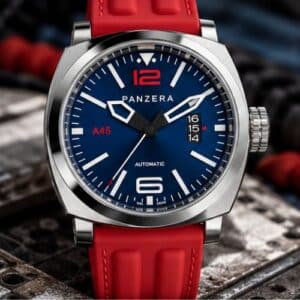 That got them thinking. What if they bypassed most of the traditional retail system? Rather than paying for expensive storefronts and relying on layers of middlemen, they could design their own watches and sell them directly to customers online. It was an ambitious plan for two men operating thousands of miles from Switzerland’s famous watchmaking valleys. But they weren’t trying to become the next Rolex. They simply wanted to make watches they could afford to collect themselves.
Their first creation took inspiration from the oversized German pilot’s watches of the 1930s. These historic aviation instruments had been designed for function rather than fashion, with large cases, highly visible numerals, and dials that could be read at a glance. Panzera’s Flieger brought that unmistakable military-inspired appearance into the modern world. It was bold, practical, and about as subtle as an airplane landing in your driveway.
The earliest Flieger watches were designed and assembled in Sydney, with most finding their way onto the wrists of friends and a handful of online customers. There were no celebrity ambassadors, glamorous boutiques, or waiting lists stretching into next year. Just two enthusiasts trying to convince people that an Australian watch company deserved a place alongside brands from countries with much longer horological histories.
And slowly, people began paying attention. The watches looked different from the delicate dress watches that had dominated earlier generations. They were large, unapologetic, and inspired by an era when watches were essential tools rather than fashion accessories. Better still, customers could buy one without taking out a second mortgage.
Success encouraged Herman and Cooper to look beyond the cockpit. The company eventually organized its collections around three worlds of adventure: air, land, and sea. Aviation-inspired watches honored the early pilots who relied on dependable instruments, motorsport designs captured the excitement of racing, and marine collections brought the rugged appearance of nautical timepieces to everyday wrists. Even the company’s navigational star logo reflected this fascination with exploration.
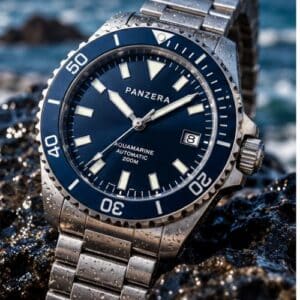 The Aquamarine collection became one of the brand’s recognizable expressions of that philosophy. Inspired by maritime instruments and diving watches, its substantial cases and bold dials carried the same attitude as the original Flieger. Panzera wasn’t interested in making watches that disappeared beneath a shirt cuff. These were timepieces designed to be noticed, whether their owners were exploring the ocean or simply navigating the grocery store.
Behind the adventurous appearance was a distinctly international operation. Panzera remained Australian at heart, with its designs originating in Sydney, while components came from established suppliers in Germany, Switzerland, Japan, and Italy. Depending on the collection, watches were assembled in Australia or Switzerland, using either Japanese or Swiss movements.
The numbers eventually told their own story. From those first watches sold to friends in Sydney, Panzera grew into an international business, selling primarily online and direct to customers. The company now reports delivering more than 300,000 timepieces to customers in over 100 countries.
Panzera doesn’t have the history of Omega, the prestige of Patek Philippe, or the name recognition of Rolex. It wasn’t founded by a legendary watchmaker determined to revolutionize mechanical engineering. It was created by two ordinary collectors who looked at the watch industry and wondered why things had to be so expensive. More than fifteen years later, the company continues to produce watches inspired by aviation, motorsports, and the sea.
Perhaps the most unexpected chapter came when pilots from the U.S. Air Force’s Aggressor Squadron commissioned a custom Panzera watch based on the Flieger 45G. Some had already purchased the brand’s watches online before approaching the company. For two Australians who started by designing watches inspired by military aviation, having actual fighter pilots request their own version was quite a turnaround.
And that brings us back to Sydney Harbour in 2009, where two friends sat discussing their love of watches over a few drinks. Neither was a watchmaker. Neither had a famous Swiss family name. Yet their conversation eventually led to a watch company whose creations would find their way onto wrists in more than 100 countries.
Not bad for two guys who simply thought watches cost too much.