
It begins with a quiet, almost unreasonable sensation—the moment you fasten a vintage watch to your wrist and feel, inexplicably, accompanied, as if time itself has leaned closer to you—because this watch was never meant for you, and yet here it is, resting against your pulse, carrying the gravity of another life that once trusted it enough to mark mornings, waiting, courage, fatigue, and the fragile seconds before something mattered.
 This is what separates a vintage watch from any modern object: it does not arrive blank. Someone chose it, relied on it, reached for it without thinking, and allowed it to witness both the ordinary and the irreversible; it measured boredom and urgency alike, the long stretches of routine and the moments when everything changed, and when you wear it now, you are not simply keeping time, you are inheriting care, attention, and an unspoken agreement that something once loved should not be allowed to fall silent. There is, of course, a particular power when that watch is an heirloom—when it ties you directly to your own past, your own blood or memory—but what gives the feeling its weight is not lineage alone, it is continuity, the idea that meaning survives by being carried forward.
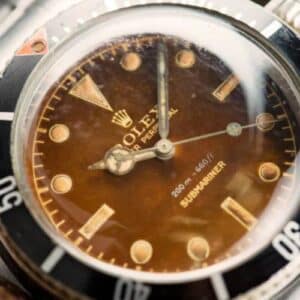 A vintage watch compels not because it is old, but because it has already endured; it has survived uncertainty, fashion, neglect, and chance, and still it keeps moving, which gives it a gravity no modern object can imitate, because time itself has tested this thing and allowed it to continue. You feel that truth most clearly when you wind it, that subtle resistance beneath your fingers, a ritual that feels less like maintenance and more like acknowledgment, as if each turn of the crown quietly says I see you, I will keep you moving, I will not let what mattered to you end here.
This is where the feeling of a guardian angel gently takes shape—not as superstition or myth, but as something far more believable—because the watch does not protect you by warning or intervening, it protects you by presence, by example, by reminding you that it has already stood beside someone through uncertainty and remained steady, and now it offers that same steadiness to you; the scratches stop reading as damage and begin reading as loyalty, the softened edges as proof of years spent exactly where a watch belongs, close to consequence, close to choice, close to a beating heart.
Over time, possession quietly becomes partnership, and borrowing history becomes extending it, hour by hour, life by life, because every glance at the dial says this mattered once and matters again, and in that continuation there is comfort, dignity, and an unexpected companionship, the realization that time, when treated with care, does not abandon us at all—it stays, ticks steadily on, and asks only that we keep listening.