
Watch and Clock Repair Blog
In September 2026, Blancpain released a mechanical watch measuring 19 millimeters across. In an era when a 36mm watch gets called small, that number looks almost like a typo. The new Lady B is barely more than half that width, and Blancpain didn’t build it that small by accident. It built it that small on purpose, to mark 70 years since a watch called the Ladybird first appeared in 1956.
To understand why Blancpain would do that, you have to go back to 1932, when the company nearly didn’t survive long enough to make watches at all. That year, Blancpain’s owner died. Frédéric-Emile Blancpain was the seventh generation of his family to run the company founded in Villeret in 1735. But when he died, there was no family member waiting to become generation eight. The Blancpain family’s extraordinary run was over, and the company could have been over with it.
 Instead, a woman who had joined Blancpain as a teenager decided she wasn’t going to let that happen. Her name was Betty Fiechter. She had started working for Blancpain in 1912, when she was just 16 years old. Over the next two decades, she learned the watch business from the inside: production, sales, management and the complicated machinery required to keep a Swiss manufacture alive.
Then her boss died. Fiechter and Blancpain sales director André Léal scraped together their savings and bought the company. On July 7, 1933, Betty Fiechter became co-owner and head of Blancpain, becoming what the company describes as the first woman to lead a major watchmaking manufacture.
Think about the timing. It was 1933. The world was deep in the Great Depression. Swiss watchmaking was struggling. Europe was moving toward another war. The watch business was dominated almost entirely by men. And Betty Fiechter had just bought a watch company.
There was another complication. Since nobody from the Blancpain family owned the company anymore, Swiss law prevented the new owners from simply continuing under the old family business name. The manufacture became Rayville S.A., successeur de Blancpain—”Rayville” essentially being a rearrangement inspired by Villeret. The watches, however, continued carrying the Blancpain name.
Then Fiechter was hit again. In 1939, André Léal died unexpectedly. The partner with whom she had purchased Blancpain was gone, leaving Fiechter responsible for steering the company into the most destructive war Europe had ever seen. She kept going.
Instead of simply trying to survive by making the same watches everyone else was making, Fiechter steered Blancpain toward something almost nobody else could do well: tiny watches. Women’s wristwatches were getting smaller and more jewelry-like, and Fiechter saw what that fashion shift actually demanded: not just a smaller case, but a smaller machine hiding inside it.
The gears still had to turn. The balance still had to oscillate. The escapement still had to work. The mainspring still had to store enough energy to keep the watch running. Most watchmakers treated that as a limitation. Fiechter treated it as Blancpain’s opening.
Then, in 1950, another Fiechter arrived at Blancpain. Her nephew Jean-Jacques joined the company, and aunt and nephew would oversee one of the strangest periods in Blancpain history—because within just a few years, the company produced two watches that were almost complete opposites.
First came a watch built to go underwater. In 1953, Blancpain introduced the Fifty Fathoms. Jean-Jacques Fiechter was himself an enthusiastic diver, and Blancpain worked with French combat divers Captain Robert “Bob” Maloubier and Lieutenant Claude Riffaud on a watch designed for serious underwater use. The Fifty Fathoms would become one of the defining early modern dive watches.
Three years later, Blancpain went in completely the opposite direction. Instead of making a watch tough enough for military divers, it tried to make one almost disappear on a woman’s wrist—the strategy Betty Fiechter had been building toward since the 1930s.
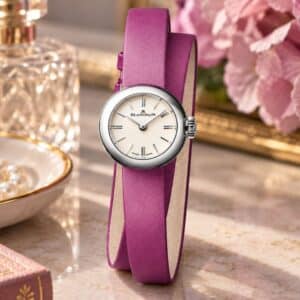 In 1956, Blancpain introduced the Ladybird. Inside was the caliber R550. The movement measured only 11.85 millimeters across. That’s smaller than a dime. Yet Blancpain had managed to squeeze a functioning mechanical watch movement into that space, including a power reserve exceeding 40 hours. One pivot associated with the escape wheel measured just 0.07 millimeters in diameter.
Suddenly Blancpain had two calling cards. One was built for men disappearing beneath the ocean. The other was built small enough to hide inside jewelry. And Betty Fiechter had helped build the company capable of making both.
Seventy years later, Blancpain went back to that second idea. The new Lady B isn’t just a smaller watch for the sake of being small. It’s Blancpain reaching back to the exact philosophy Fiechter pushed the company toward when everyone else assumed miniaturization was somebody else’s problem.
But there’s something about Betty Fiechter’s story that’s even more remarkable than the watches. She was running a Swiss watch company at a time when women in Switzerland couldn’t even vote in federal elections.
She could own Blancpain. She could employ people. She could negotiate contracts. She could help determine which watches the company would manufacture. She could help guide a Swiss business through the Depression and World War II.
But she couldn’t cast a ballot in a Swiss federal election. Swiss women wouldn’t gain that right until 1971. By then, Fiechter’s career was essentially over. Her watches weren’t.
And it all leads straight back to a 16-year-old girl who walked into a Swiss watch company in 1912 and stayed long enough to eventually own it. When the Blancpain family disappeared from Blancpain, she stayed. When her business partner died, she stayed.
Blancpain has been making watches since 1735. But there was a moment when its future rested in Betty Fiechter’s hands, and the watch on shelves this month is still, in its own small way, proof of what she did with it.