
Most visitors to the Smithsonian’s Air and Space Museum arrive expecting spectacle—silver jets, roaring engines, spacecraft that carried human beings into the void. That’s why the small Hampden pocket watch sitting quietly behind glass is so disarming. It doesn’t glow, spin, or hover. It’s just a modest American timekeeper, a warm yellow-gold case worn smooth by life in a working man’s pocket. And yet, against all expectation, this little watch was there—actually there—on the day humanity left the ground for the first time. It rode in Orville Wright’s coat, ticking steadily as the world shifted beneath him.
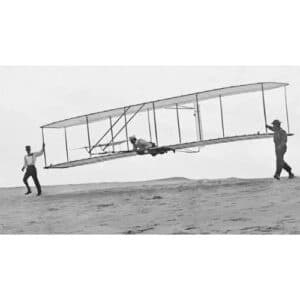 To understand the magic of this watch’s journey, you have to picture Kitty Hawk as it truly was in 1903. It wasn’t a postcard beach, and it certainly wasn’t the soft, sunny Carolina coastline people imagine. Kitty Hawk was a lonely stretch of wind-ripped sand dunes on North Carolina’s Outer Banks, a place chosen not for charm but for its fierce, consistent winds, soft landing surface, and merciful isolation. In winter the landscape looked almost lunar—endless pale sand, salt-tough grasses, and winds so sharp they could peel the warmth off your bones. On the morning of December 17, the air was brittle with cold, the sky a washed-out gray, and every footstep sank silently into the dunes. The Wrights had been living there for weeks in a makeshift wooden shed that groaned under the wind, cooking on kerosene stoves, mending canvas in lamplight, and recording every experiment in tidy, deliberate handwriting. That morning, frost glazed the sand, and gulls wheeled overhead as if unsure whether to flee or stay to witness whatever these strange men were trying to coax into the air.
The watch Orville carried into that bitter wind came from the Hampden Watch Company, a name well known in American horology. Hampden began in Springfield, Massachusetts in 1877 before moving operations to Canton, Ohio under John C. Dueber, whose factories specialized in honest, dependable watches for railroad workers, engineers, and craftsmen. Hampden wasn’t a luxury house—they made practical tools: 16- and 18-size movements with 11 to 15 jewels, sturdy three-quarter plates, steel escape wheels, and lever-set mechanisms designed to prevent accidental time-setting during hard work. Their cases were built to endure sweat, grit, and weather, not velvet-lined jewelry boxes. In other words, exactly the sort of watch the Wright brothers, meticulous and frugal as they were, would trust. A Hampden didn’t try to impress; it tried to perform.
And though the original company later slipped into history, the name has quietly found its way back into the present, returning in 2025 under Chicago stewardship—proof that some stories never truly go still.
And so, as Orville lay prone on the Flyer that morning—his gloved hands gripping the wooden controls, the new gasoline engine sputtering behind him, the canvas wings trembling like an animal ready to bolt—the Hampden ticked under his coat with quiet determination. Time mattered to the Wrights. Every trial was measured: how long the engine held power, how many seconds until the wing dipped, how far the craft traveled before succumbing to the wind. They weren’t chasing a miracle; they were gathering data, one timed experiment after another. When the Flyer’s skids scraped forward along the launching rail, when the machine rose awkwardly but undeniably into the air, when Wilbur ran beside it cheering wildly, the Hampden marked every heartbeat of those twelve history-defying seconds.
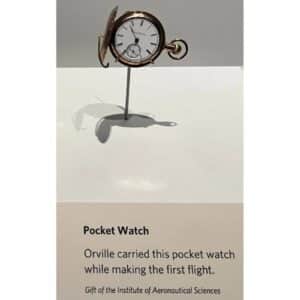 Today, that same pocket watch sits behind museum glass—a tiny thing overshadowed by the mechanical giants around it. But its presence is profound. It reminds us that the first powered flight wasn’t guided by instruments or dashboards or any of the aviation tools we now take for granted. It was guided by grit, engineering, dreams—and the steady, unassuming rhythm of an American pocket watch built in an American factory. The Hampden didn’t know it was witnessing the dawn of flight. It simply kept time. But in doing so, it became part of the moment the sky opened for the first time and humanity stepped through.