
If you’ve spent any time poking around the vintage watch world, you’ve probably bumped into the Gruen name. It’s one of those brands that collectors either know deeply or have somehow never heard of. If you’re in the “never heard of it” camp, buckle up, because Gruen is fascinating once you start digging in.
The company built three distinct watch lines that collectors still chase today: the Curvex, the Veri Thin, and the Precision. They’re not interchangeable. They’re not even really comparable. Each one was built to solve a completely different problem, and knowing the difference is the kind of thing that separates a savvy collector from someone who accidentally buys a headache.
Whether you find yourself in need of Gruen watch repair or you’re just looking to learn a bit more about a Gruen watch you’ve come across, understanding which line you’re dealing with is step one.
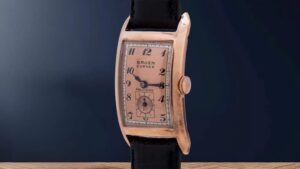
The Company: Cincinnati’s Swiss Connection
Gruen Watch Company was founded in Cincinnati, Ohio, by Dietrich Gruen, a German immigrant who came to the United States in the 1870s with significant watchmaking experience.
The company eventually carved out a really interesting niche. The key to understanding Gruen is the fact that it didn’t manufacture everything in-house. Instead, the company worked with Swiss suppliers through an arrangement called the Gruen Guild, developing movements to its own specs and then building distinctly American-styled cases around them.
Think of it like a chef who sources ingredients from the best farms but creates entirely original dishes. The components were Swiss. The vision was American. The result was a catalog built on design differentiation rather than just grinding out the cheapest possible timepiece. That philosophy gave birth to three lines that served three very different customers, and it’s what makes a Gruen collection so interesting to look at side by side.
The Curvex: When Engineers Got Ambitious
The Curvex is the line that announced, loudly, that Gruen’s engineers were not here to play it safe. Introduced in the 1930s, it was built around a wild idea: what if the movement itself curved to follow the shape of your wrist?
Most watches of that era sat flat on the wrist, which meant the edges kind of floated above the skin. Gruen’s engineers rethought the entire internal architecture, arranging the plates, bridges, and gears along a gentle arc so the case could curve downward at both ends and sit flush with the wrist. It’s the kind of mechanical problem-solving that sounds simple until you realize you’re basically asking all the tiny gears to cooperate while living on a gentle slope.
The Curvex launched right in the heart of the Art Deco era, which turned out to be perfect timing. The combination of that curved engineering and the long, narrow, geometric case design produced something that felt almost sculptural. Put a Curvex next to a standard rectangular dress watch from the same period and the difference is immediately obvious. It just sits differently on the wrist. It looks like it belongs there.
For collectors, this is the line with the most cachet. It’s also the one that requires the most caution. Those curved movements are significantly more difficult to service than a standard flat caliber. A Curvex that’s been sitting in a drawer for 40 years with dried-out lubricants is not something you want to hand to just any watchmaker.
Finding someone with actual professional watch repair experience on these curved movements isn’t optional. It’s the single most important decision you’ll make to protect your vintage Gruen. A poorly serviced Curvex can look perfectly fine on the outside while quietly falling apart on the inside. Research the watch before you buy it, and vet your watchmaker just as carefully before handing it over.
The Veri Thin: Understated Elegance
The Veri Thin line took the opposite approach. Where the Curvex was about engineering complexity, the Veri Thin was about stripping everything down to its essential form. The name really does tell the whole story. These watches were engineered to be as slim as the technology of the era would allow, and every design decision served that goal.
Gruen sourced movements with reduced plate thickness and minimal complications. The cases were correspondingly shallow. The dials tend to be clean and restrained, with simple hour markers and almost nothing extra. The overall effect is a watch that doesn’t call attention to itself so much as quietly reward anyone who happens to notice it. It’s the difference between a neon T-shirt and a well-cut suit.
The Veri Thin was aimed squarely at buyers who associated quality with restraint, which aligns with how many mid-century American professionals thought about style. If you wanted a watch to wear to the kind of dinner where you discussed business without looking like you were discussing business, a Veri Thin was the move.
From a practical collecting standpoint, the Veri Thin might be the easiest entry into the Gruen world for someone who actually wants to wear a vintage watch. The slim profiles work surprisingly well with modern dress standards. A properly serviced Veri Thin under a dress shirt cuff is essentially invisible until the moment it isn’t, which is exactly what the design intended.
The Precision: The Reliable Workhorse
The Precision line is where Gruen targeted the everyday buyer, and it’s the most straightforward of the three. There’s no engineering gimmick here, no pursuit of radical thinness. The Precision line was built around a simple promise: accurate timekeeping, without drama, at a reasonable price.
Gruen marketed the Precision based on timekeeping performance. The watches were regulated and tested to a tight tolerance that made them impressively accurate by the era’s standards. The name was a deliberate signal of that. You weren’t buying a conversation piece. You were buying a reliable tool that happened to look good.
The movements in Precision watches are conventional flat calibers, well-finished for their time but built without the dimensional constraints of the other two lines. The cases vary more than the Curvex or Veri Thin, partly because “Precision” was a designation that covered a wide range of production and price points across multiple decades.
A Precision from the 1940s and a Precision from the 1950s can look like they came from completely different brands, since the design language across the whole industry shifted significantly during that period.
Which One Is Right for You?
The line a Gruen belongs to tells you what questions to ask next. A Curvex demands that you think about service history before anything else. Confirm it’s been properly maintained (or accept that it may need significant work), and find a watchmaker who specifically knows curved movements. Skip that step, and you’re gambling.
A Veri Thin rewards buyers who want to actually wear their vintage watches regularly. The movements are approachable, the designs hold up well against modern taste, and a properly serviced example is practical as a daily wearer.
A Precision is the widest on-ramp into Gruen collecting. The range of available models is broad, prices tend to be more accessible, and the movements are familiar territory for a watchmaker who regularly works on mid-century calibers.
None of these lines is objectively the best one. They were built for different purposes by a company that understood its customers well enough to serve multiple of them at once. The watch you’re looking at will tell you which conversation you’re actually having, as long as you know enough to listen.