
Two people can share the same name and have little else in common. That’s Jules Jürgensen in a nutshell. The original was a 19th-century Danish watchmaker trained under his father, Urban Jürgensen, and respected across Europe for work that still holds up under a loupe today. The American brand that later carried the name operated in a different era and a different tradition entirely.
What connects the two is the name. What separates them is most of what actually went into the watches.
The version of Jules Jürgensen you have makes a big difference when it comes to professional watch repair services. How the watch was made, when it was made, and what materials went into its movement all shape what repair requires and what to expect from the result.
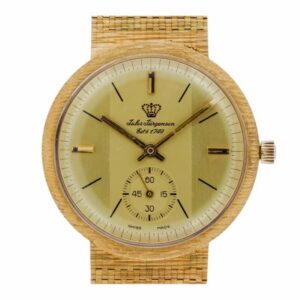
The Build of Vintage Jules Jürgensen Movements
The Jules Jürgensen watches that collectors pursue most actively come from the mid-20th century, an era when the brand was producing dress watches with Swiss movements sourced from respected caliber manufacturers. These were not movements stamped out in volume and assembled by machine. They were hand-finished, hand-regulated, and fitted with tolerances that required skilled attention at each stage of assembly.
In a hand-finished movement, surfaces are beveled and polished by hand. Parts are fitted individually to the specific movement they go into. They aren’t always interchangeable with identical components from the same production run. Jewels are set precisely, balance wheels are poised carefully, and the regulation is adjusted over time by a watchmaker who knows the specific behavior of that caliber.
All that care and expertise result in a movement that can perform at a high level for decades, provided it receives proper care along the way.
The materials used in that era also differ meaningfully from what followed. Steel components were cut from higher-grade stock. Brass plates and bridges were machined to tighter specifications. Mainsprings were made from alloys selected for longevity under repeated winding. None of this makes vintage movements invulnerable to time, but it does explain why so many of them are still running after 50 or 60 years of wear.
What Decades Do to a Movement Built That Way
A vintage Jules Jürgensen movement in service today has spent decades cycling through temperature changes, humidity fluctuations, and the gradual effects of oxidation. Every one of those cycles leaves a trace.
Lubricants Degrade
Lubrication is the most immediate concern. The oils applied when a movement was last serviced degrade over time, thickening, drying, or migrating away from the surfaces they were applied to protect.
A movement running on dried lubrication isn’t running well. It’s generating friction at every point of contact between moving parts. That friction creates wear that accumulates until something fails or timing degrades noticeably. A vintage watch that hasn’t been serviced in 10 or 15 years is almost certainly running on lubrication that has long since passed its useful life.
Pivots Wear
Pivot wear is what dried lubrication leaves behind when it goes unaddressed long enough. The pivots on a balance wheel or gear train are extremely fine, often less than a fraction of a millimeter in diameter. That’s thinner than a strand of hair. They run in jeweled bearings designed to provide a frictionless surface.
When the oil is gone and metal contacts metal repeatedly, those pivots wear down. A worn pivot changes how the balance wheel swings, affects timing accuracy, and eventually leads to complete failure of that arbor (the axle the wheel turns on).
Corrosion
Corrosion rounds out the damage trifecta. Moisture that found its way into the case over the years leaves rust on steel components, and that rust doesn’t stay put. It spreads to adjacent parts, weakens metal that was already at fine tolerances, and eventually makes components brittle or dimensionally inaccurate. A pivot corroded to 80% of its original diameter behaves differently than a new one, and no amount of cleaning corrects that. It needs a replacement part with the correct dimensions.
Sourcing Difficulties
Parts sourcing for vintage movements adds another layer of complexity. Some components are available through the secondary market or watchmaker inventories. Others have to come from donor movements, pulled carefully from another watch of the same caliber. In cases where a part is genuinely unavailable, skilled watchmakers fabricate it from scratch, working from original specifications to produce a component that fits and functions as intended.
What Changed When Modern Production Took Over
Jules Jürgensen watches produced from the later decades of the 20th century onward reflect a different manufacturing philosophy. The watchmaking industry had shifted broadly toward standardized ebauches, movements produced in large volume by caliber manufacturers and used across many brands simultaneously. The Jules Jürgensen watches made in this era typically used that approach to movements.
Standardization changes the production relationship significantly. A movement designed for use across dozens of watch brands is optimized for consistency, reliability, and serviceability at scale. The hand-finishing that characterized earlier production is largely absent. Tolerances are maintained by automated manufacturing rather than individual watchmaker attention.
These movements perform reliably and keep accurate time, but they carry less of the individual character that comes from a movement fitted by hand.
This shift also changed the materials picture in ways that aren’t purely positive or negative. Some modern movements use more corrosion-resistant materials that hold up better over time. Others use synthetic lubricants that last longer than the oils used in earlier decades. At the same time, the particular character of high-grade vintage materials, steel milled to exacting standards and finished by hand, doesn’t carry over into movements built at volume.
For you as a collector, the distinction often comes down to what first drew you to the brand. Vintage Jules Jürgensen watches attract owners who want the craftsmanship and history of that earlier production era. Modern pieces attract owners who want reliability and a recognizable name on the dial without the maintenance demands of an older movement.
Servicing a Modern Jules Jürgensen
Modern Jules Jürgensen watches built around standardized movements present a more predictable service picture. Because the calibers used are shared with many other watches, parts are generally available through normal supply channels. A watchmaker servicing one of these movements has access to replacement components without sourcing from donor watches or fabricating parts by hand.
Routine service on a modern Jules Jürgensen follows the same protocol as any quality watch from the same era. The movement is cleaned and lubricated. Worn components are inspected and replaced as needed. The case is examined for water resistance, gaskets are replaced, and the watch is pressure-tested to confirm the seal holds before it goes back on the wrist. These are the steps that keep a watch reliable for another decade of wear.
What This Means When You Bring One In
Fixing a Model T calls for a different approach and skillset than fixing a 21st-century Mustang. Similarly, the right approach to Jules Jürgensen watch repair or service depends almost entirely on which generation of the watch you own.
Vintage pieces from the mid-century production era call for a watchmaker with experience in older Swiss calibers and the patience to source or fabricate parts that haven’t been manufactured in decades. Modern pieces call for thorough, competent service from someone familiar with the contemporary calibers inside them.
Both categories benefit from regular maintenance rather than waiting for something to fail. A vintage Jules Jürgensen that gets serviced on a reasonable schedule, roughly every five to seven years, keeps its lubrication fresh and heads off the pivot wear and corrosion that make restoration so much more involved. A modern piece serviced on the same schedule stays water-resistant and runs accurately well past the point when a neglected watch would have developed problems.
The brand covers two distinct eras of watchmaking. Each era produced watches worth keeping. What they share is a need for the kind of service that matches how they were built.