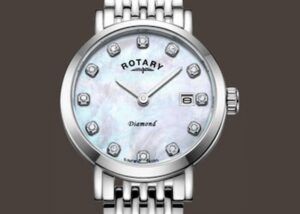
You know how shoe enthusiasts can tell a lot about someone from their footwear? Watch people are the same way, except they’re staring at your wrist and reading a logo roughly the size of a grain of rice.
Rotary has been making watches since 1895, and like any company that’s been around that long, the branding has changed. A lot. The logo on the dial today looks nothing like it did 70 years ago, and those differences are useful information if you know how to read them.
The logo versions are not trivial distinctions. For collectors, they can influence what a piece is worth. For owners, they help determine what proper care requires.
A Brief Look at Rotary’s Logo History
Rotary Watches was founded in 1895 by Moise Dreyfuss in La Chaux-de-Fonds, Switzerland, one of the most historically significant centers of watchmaking in Europe. The brand has operated continuously since then, so its visual identity has gone through many chapters. That story covers changes in design, ownership, and market positioning.
The early Rotary wordmark was typographically clean, consistent with the Swiss watchmaking tradition of the late 19th and early 20th centuries. Throughout the mid-20th century, the logo underwent several refinements in letterform and proportion.
Later decades brought more stylized treatments. The letterforms changed. The “R” got tweaked. Font weights came and went. There were adjustments in how the brand name was paired with country-of-origin text or movement designations on the dial.
Collectors and historians of the brand have pieced together a detailed timeline of those changes. That matters beyond trivia, because Rotary watch repair looks very different depending on which era of the brand you’re working with.
The logo alone can often narrow down when a watch was made to within a decade or so. That’s like being able to tell what year a friend graduated high school just by looking at their yearbook photo hairstyle. Once you know what you’re looking at, the information is right there.
Why Logo Variations Matter to Collectors
Things quickly get interesting for anyone who likes the idea of finding a hidden gem at an estate sale or on a secondary market site. Certain eras in Rotary’s history line up with movements that collectors get excited about. Really, really excited about.
Watches from the mid-20th century often feature Swiss ébauchemovements sourced from respected suppliers of the time. Some of those calibers have fans completely independent of the Rotary name. People collect the movements like others collect vinyl records, partly for their technical qualities and partly just because they love what they represent.
When a logo places a watch in one of those production windows, it’s a clue about what’s probably inside. Rarer logo variants may appear on limited-run models, export-market pieces, or watches produced during transitional production periods. Those tend to be harder to find in decent shape, which makes them more appealing to people who take this stuff seriously.
The practical upshot is this: someone who knows Rotary logo history can spot value that a casual buyer walks right past. The dial is readable by anyone. The meaning behind it becomes clear only after you’ve done a little homework.
Older Logos, Older Movements
A Rotary with an older logo is, by definition, an older watch. Older watches have older movements. And older movements are not always simple to service.
Parts for mid-century Swiss calibers aren’t sitting on a shelf at some warehouse waiting to be ordered online like a spare air filter. Discontinued gaskets, mainsprings, balance wheel components, and other wear items may require a little creativity. Your watch repair expert may source them from old-stock suppliers, adapt them from similar calibers, or, in some cases, fabricate them from scratch. That requires a watchmaker who knows the original tolerances well enough to work within them.
None of that is impossible. An expert in professional watch repair who specializes in vintage movements deals with exactly this kind of puzzle on a regular basis. They can source, alter, or make parts from scratch. The technician at a strip mall who spends most of the day replacing batteries and sizing bracelets? This is probably not the watch to learn vintage movement restoration on.
Hand that same vintage Rotary watch to a generalist shop or someone whose experience is mainly with modern quartz movements or current-production automatics, and you’re rolling the dice. It might come back looking fine while carrying components that don’t belong in it, or with service work that didn’t account for what the movement truly needs.
The logo on the dial is often your first clue that the movement inside may require specialized experience, not just general capability and a free afternoon.
Service on Some Models Was Never Simple
Certain Rotary models were complicated from day one. Export-market variants made for specific regional distribution sometimes used calibers that weren’t widely adopted elsewhere. Limited-run models occasionally had movements or case configurations unique to that production run.
These watches are often the most sought-after ones, partly because of their rarity. But that rarity extends to technicians who’ve actually worked on them. There’s real value in working with a watchmaker who has handled a specific caliber before. Familiarity with the movement’s quirks and common failure points can make a meaningful difference.
If a logo and dial markings suggest your watch falls into a less common category, take that seriously when choosing who to trust with it. Mistakes on a rare movement affect both function and value in ways that are hard to undo.
When the Logo Should Prompt Professional Watch Restoration
Not every vintage Rotary with an old logo needs emergency intervention. Plenty of them are running just fine and simply need periodic servicing. But a few situations call for closer attention.
A watch with logo markings pointing to a known production window for unusual movements, especially export models or regional variants, may hold a caliber most generalists have never seen. That’s worth factoring into your hiring decisions.
A piece that’s clearly been opened and worked on before, with no documentation of what was done, carries compounded uncertainty. The older the movement and the murkier the service history, the more important it is to have someone with real experience take a look before you assume everything is fine.
For collectors, logo recognition also helps frame a practical question about long-term preservation. A watch sitting unserviced in a collection will eventually reach a point where the work is harder and more expensive than it would have been if you’d gotten ahead of it. At seven years between services, many watches are still in relatively manageable condition. At 20 years, deferred maintenance can turn a routine service into a much larger restoration project.
The Small Print Tells a Big Story
That little logo on a Rotary dial isn’t just a brand mark. It’s a compressed version of the watch’s biography. It tells you roughly when the watch was made, what’s likely inside it, and what kind of expertise future service work may require.
Whether you’re a serious collector or someone who inherited a Rotary from a grandparent and wants to know if it’s worth servicing, understanding what the logo signals puts you in a better position. You’ll know what questions to ask, and you’ll know who’s actually equipped to answer them.
Video

Infographic
Rotary’s logo history stretches back to 1895, and each visual era maps to specific movements, production windows, and servicing challenges that matter deeply to collectors and owners making informed decisions. Discover six things to know about Rotary watch logos in this infographic.