
If you walked into a jewelry store and saw a watch with no numbers, no hour markers, and almost nothing on the dial, what would you think? Most people would probably reach the same conclusion: it isn’t finished. That was exactly the reaction many had when they first encountered the design that would become the Movado Museum Dial. What looked incomplete would go on to become one of the most celebrated watch designs ever created, earn a permanent place in New York’s Museum of Modern Art, and forever change the idea of what a watch could be. Sometimes, making a lasting impression comes down to knowing what to leave out.
 The story begins in 1947 with American industrial designer Nathan George Horwitt. Unlike the Swiss watchmakers surrounding the industry, Horwitt approached watches as an artist rather than an engineer. Influenced by the minimalist ideals of the Bauhaus movement, he believed great design wasn’t about decoration—it was about purpose. While other manufacturers competed to add more numerals, more markers, and more detail, Horwitt asked a question no one else seemed interested in asking: How little can a watch display and still tell time?
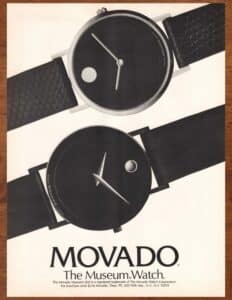
His answer was daring. He erased nearly everything from the dial, leaving only the hands and a single gold dot at the 12 o’clock position. That dot wasn’t simply a design choice. It represented the sun at high noon, the highest point in the sky, while the moving hands symbolized the Earth’s rotation beneath it. In one elegant gesture, Horwitt transformed the modern wristwatch into an abstract version of humanity’s oldest timekeeper—the sundial. Once you understand the symbolism, the dial no longer appears empty. Every element that remains has a reason for being there.
The watch industry didn’t quite know what to make of it. Some admired its bold simplicity, while others wondered whether something had been left off by mistake. Yet as the debate continued, the art world reached a very different conclusion. In 1960, New York’s Museum of Modern Art added Horwitt’s dial to its permanent collection, making it the first watch dial ever recognized as a work of modern art. The honor gave rise to the name “Museum Dial,” and it has been known by that name ever since.
Recognition, however, didn’t settle everything. Horwitt had created the design independently, and when Movado began producing watches featuring the dial, a lengthy legal dispute followed over who owned the rights. The two sides eventually reached a settlement in 1975, officially linking Horwitt’s creation with the Swiss watchmaker. What could have become a footnote instead became part of the legend, strengthening the connection between the designer and the brand that would make the dial famous.
Nearly eighty years later, countless watch designs have come and gone, but the Museum Dial remains instantly recognizable. It has no elaborate complications, no intricate patterns, and no flashy display competing for attention. Just one small gold dot that continues to spark curiosity in people seeing it for the first time. The question hasn’t changed since 1947: “Where are the numbers?” That’s exactly what Horwitt wanted people to ask. By taking almost everything away, he created a design that people have never stopped talking about—a timeless reminder that less isn’t always less. Sometimes, it’s unforgettable.