
The promise of a solar watch is one of the more appealing things in watchmaking: a timepiece powered by light, designed to run indefinitely without battery changes or winding. Then yours stops, and no amount of sunbathing brings it back. You set it on the windowsill for three hours in full afternoon sun, check it again, and the hands still haven’t moved. Something is wrong, but figuring out the problem doesn’t always call for professional watch repair. It starts with understanding how the charging system actually works and where it can fail.
Seiko Solar watches are smarter than the “just add sunlight” pitch suggests, and that complexity is exactly why Seiko solar repair sometimes takes more than a few hours in a sunbeam. Three main causes account for almost every case, and each one points toward a different solution.
Let’s look at how the system works and the three main causes most likely at play if your Seiko has stopped.
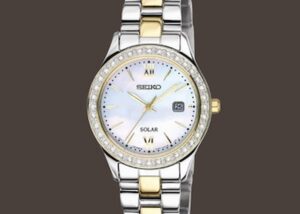
How the Charging System Works
A Seiko Solar watch generates power when light strikes a thin photovoltaic panel built into the watch’s dial. The panel converts the light into electricity and routes it to a small rechargeable lithium-ion cell inside the movement. That cell powers the quartz movement, even in darkness, drawing down its reserve until light charges it again.
The key difference from a traditional battery is that this cell is designed to be charged and discharged repeatedly over years of use. It isn’t a passive power source waiting to be depleted. It’s an active component that cycles through energy storage and release over and over throughout the watch’s entire lifespan.
That design is what makes the watch perform so reliably for years. It’s also what creates specific failure points that don’t exist in a conventional quartz watch.
The Rechargeable Cell: The Part That Wears Out
The most common reason a Seiko Solar stops is a degraded rechargeable cell. Even the best engineering can’t create a rechargeable battery that lives forever. Eventual degradation is a predictable result of how rechargeable cells behave over time.
Each charge-discharge cycle causes microscopic changes in the cell’s internal chemistry. Over many years and thousands of cycles, the cell’s ability to hold a charge diminishes. Early on, this is invisible. The watch charges quickly, holds its reserve for months, and performs exactly as designed.
Later, you might start to notice shorter run times away from light. The watch might need more regular exposure to stay accurate. Eventually, the cell reaches a point where it charges poorly, discharges quickly, or can no longer deliver enough voltage to run the movement consistently.
A degraded cell doesn’t always fail all at once. Some cells hold a partial charge for a while, producing intermittent problems that can look like something mechanical is wrong. The watch runs a little fast or slow, stops and starts unexpectedly, or only fails at night after hours away from light. Think of these patterns as the cell trying to tell you something.
Certain signs point fairly clearly to a cell condition problem:
- A watch that stops after just a few days off the wrist
- One that charges normally but drains within a week
- One that has become noticeably harder to keep running in winter or low-light months
Any of these is likely dealing with a cell past its reliable life. Seiko Solar cells typically hold up for a decade or more under normal use. A watch that’s been running for 12 to 15 years without service is a strong candidate for a cell replacement regardless of whether anything dramatic has failed.
Over-Discharge Protection: When the Watch Intentionally Stops
One of the less intuitive features of Seiko Solar watches is a protection circuit that stops the watch entirely before the cell fully depletes. The movement shuts down on purpose. This is the horological equivalent of pulling over before you run out of gas.
When cell voltage drops below a certain threshold, the movement shuts down rather than allowing the cell to discharge past the point of safe recovery. A lithium-ion cell drained completely past that threshold can suffer permanent chemical damage to its internal structure. The watch stops early, deliberately, to prevent that outcome.
The resulting symptom is a stopped watch that doesn’t respond to light the way you’d expect. You put it in the sun for an hour. Nothing. Another hour. Still nothing. A cell that has entered protection mode may not accumulate enough charge to restart from brief or indirect exposure. It needs sustained, direct, high-intensity light to build enough voltage to exit the protected state.
Strong direct sunlight is the standard recommendation, typically for several hours. Manufacturers often specify five to 10 hours of direct exposure for a deeply discharged cell. Indoor light, overcast-sky light filtering through a window, or a few minutes on a sill usually aren’t enough. The cell needs a real charge, not ambient light, before the movement will restart.
This situation is often recoverable. A cell that entered protection mode due to extended storage in the dark can often be revived with the right amount of light exposure. A battery cell that has degraded enough to enter protection mode from normal wear, or one that enters it repeatedly despite regular light exposure, is a different problem. Recovery alone doesn’t solve that.
Reduced Light Transmission: When the Panel Can’t Get Enough
A third, often-overlooked possibility is that light isn’t reaching the solar panel as efficiently as it should. The photovoltaic panel sits beneath the dial, and anything that reduces light transmission directly affects how well the watch charges.
Seiko Solar dials are engineered to allow light to pass through while maintaining the appearance of a standard watch face. Over time, surface scratches on the crystal, accumulated grime, or mineral deposits from water exposure can scatter or block light before it ever reaches the panel. A watch worn daily without much cleaning, or one stored with residue built up on the dial or crystal, may charge noticeably less efficiently than it did when new.
Damage is the more serious case. A deep scratch across the dial, a cracked crystal, or a coating that has degraded over years can reduce light transmission in ways that can’t be cleaned away.
This cause is worth checking first because it costs nothing to rule out. Clean the crystal gently with a soft cloth, give the watch several hours of direct sunlight with the dial fully exposed, and see whether the charging behavior changes. A watch that starts charging normally after cleaning pointed you directly to the cause. One that still doesn’t respond after cleaning and extended exposure needs a closer look.
Summing It Up
These are the common patterns:
- A watch that charges briefly and drains within days is almost certainly a cell issue.
- A watch that stopped cold after a long time in storage is a protection-mode candidate that might recover with prolonged direct sun.
- A watch that charges slowly and never reaches full reserve after extended light exposure, but continues to run, is likely dealing with either a cell approaching its end of life or reduced light transmission through the dial.
Sometimes You Need the Pros
Seiko solar repair work that goes beyond a basic cleaning and recharge test involves evaluating the cell’s actual charge capacity, testing how efficiently the panel is charging it, and checking whether the movement’s internal components are in good condition. A cell replacement extends reliable service life by another decade or more and is a straightforward job for a watchmaker with experience in solar movements.
If you’ve run through the basic troubleshooting steps and you’re still stuck, guesswork isn’t the answer. Professional evaluation is.