
Your Boston watch stopped. You’ve got a free afternoon, a YouTube tutorial queued up, and a caseback tool that costs less than a fast food meal. How hard could it be?
Pretty hard, as it turns out. And more to the point: how badly could it go? Pretty badly. DIY watch repair is one of those activities that looks deceptively simple right up until the moment something goes wrong, and with a precision mechanism the size of a button, “something going wrong” tends to happen fast and quietly. You close the case, the watch looks fine, and two days later, you realize it isn’t fine at all.
If your Boston watch is giving you trouble, the instinct to handle it yourself is understandable. The instinct is also worth resisting. Boston watch repair is an art, and in the wrong hands, it can go as badly as a kindergartener with a box of crayons attempting to restore the Mona Lisa.
Watches Are More Unforgiving Than They Look
A watch is small, but small doesn’t mean simple. Even a basic model contains components that are easy to bend, scratch, misalign, or contaminate. The moment you open the case, you’ve crossed from owning a watch to operating on a precision mechanism.
Tiny errors produce big consequences in this environment. A slipped tool scratches the case or crystal. Too much pressure cracks a stem, bends a hand, or breaks a movement part. Dust, skin oils, or a loose fiber from a nearby cloth can get inside and quietly interfere with performance. Force anything during reassembly, and the watch may close up looking perfectly normal while something critical inside is no longer quite right.
That’s the frustrating part about DIY watch repairs that go wrong: you often don’t know they went wrong until later.
The Problem Is Often Deeper Than You Think
People assume every stopped watch just needs a new battery. Sometimes, it’s that simple. Often, it isn’t.
Corrosion, worn gaskets, internal moisture, dried lubricants, and movement damage can all stop a watch, and none of them get fixed by swapping in a new cell. Worse, replacing the battery without identifying the real issue can mask the actual problem while it continues to develop. You get a few days of running time, and then the same failure occurs, except now the watch has also been opened once by someone without the right tools or experience.
A professional starts with diagnosis before touching anything. That single step prevents a substantial amount of expensive guesswork. If it only needs a watch battery replacement, a professional can handle the job without putting your Boston watch in jeopardy of secondary damage. And if the issue is deeper, an expert can diagnose the problem and address it before things get worse.
Vintage Pieces Have Even Less Margin for Error
The older the watch, the less forgiving it tends to be. Vintage Boston watches often carry more sentimental value, more fragile materials, and fewer replacement part options. Once you damage an original dial, hand, crown, or movement part, finding a correct substitute may be difficult or impossible.
That’s why DIY work on a vintage piece can backfire so quickly. An old caseback may be tight from age. A crystal may be brittle. Internal parts may have already worn down after decades of use. Even if you manage to open the watch cleanly, the act of handling those parts without the right tools or experience can push them past their limits.
If the watch came from a family member or has any historical appeal, the cost of a mistake goes beyond repair bills. You lose originality, which is often the hardest thing to recover.
Water Resistance Is Easy to Compromise
Most people focused on getting a watch running again don’t think much about what happens when the case closes. They should. A caseback that isn’t sealed correctly becomes an entry point for moisture, dust, and sweat, none of which have any business being near a movement.
This is especially common with rushed or DIY battery replacement jobs. A gasket twists, dries out, or gets pinched during reassembly. The case feels secure. The seal is no longer working. You might not notice anything for weeks, until condensation shows up under the crystal or the movement starts showing rust.
A proper repair doesn’t just fit the part. It restores the watch’s protection so the fix actually holds.
The Right Tools Matter
Watch repair tools are specialized for real reasons. A generic pry tool, a small household screwdriver set, or kitchen tweezers can do serious damage in seconds. Watchmakers use instruments designed for specific case styles, screws, hand sizes, and stem types because the wrong shape or pressure point scars metal or snaps parts that have very little tolerance for abuse.
A few of the most common DIY casualties:
- Scratched casebacks from slipping openers
- Bent hands from poor hand-setting technique
- Damaged screws from oversized or cheap drivers
These aren’t rare accidents. They’re the predictable result of treating precision work like general home repair.
Reassembly Is Where Many DIY Jobs Fail
Taking a watch apart is one challenge. Putting it back together correctly is a different one, and it’s where a lot of DIY jobs fall apart. Alignment matters. Pressure matters. Sequence matters. One misplaced component can affect the entire watch in ways that aren’t immediately obvious.
The crown feels slightly off. The hands clear each other, but barely. The movement ring isn’t fully seated. The battery contact holds for now, but not consistently. Everything looks close enough, and close enough is exactly the problem.
That’s why a watch can seem fixed for a day or two and then stop again. And why the second attempt at repair often causes more harm than the first, because the watch has already been stressed once.
The Math on DIY Rarely Works Out
DIY repair starts as a cost-saving idea, and on the surface, that logic is reasonable. Why pay for a professional when the internet says it’s simple?
Because the cheapest repair is the one you only have to do once.
A failed home watch repair can mean case damage, missing parts, a broken stem, stripped screws, dial marks, or moisture intrusion. By the time the watch reaches a professional, the original problem may be joined by several new ones. That usually means a higher bill, fewer good options, and occasionally the painful news that something can’t be undone.
If the goal is to keep your Boston watch in good shape, the most cost-effective move is usually to avoid the avoidable damage in the first place.
The Smarter Long-Term Decision
If your watch matters to you, treat it like something worth preserving. That doesn’t mean every repair has to be elaborate or expensive. It means the work should fit the watch and the condition it’s actually in.
A good technician can tell you whether the problem is minor, whether parts are available, and whether a full service makes sense given what you’ve got. That information gives you a clear path forward instead of a guess. Your watch has already done the hard part by lasting this long. The smartest next step is giving it the kind of repair that helps it keep going.
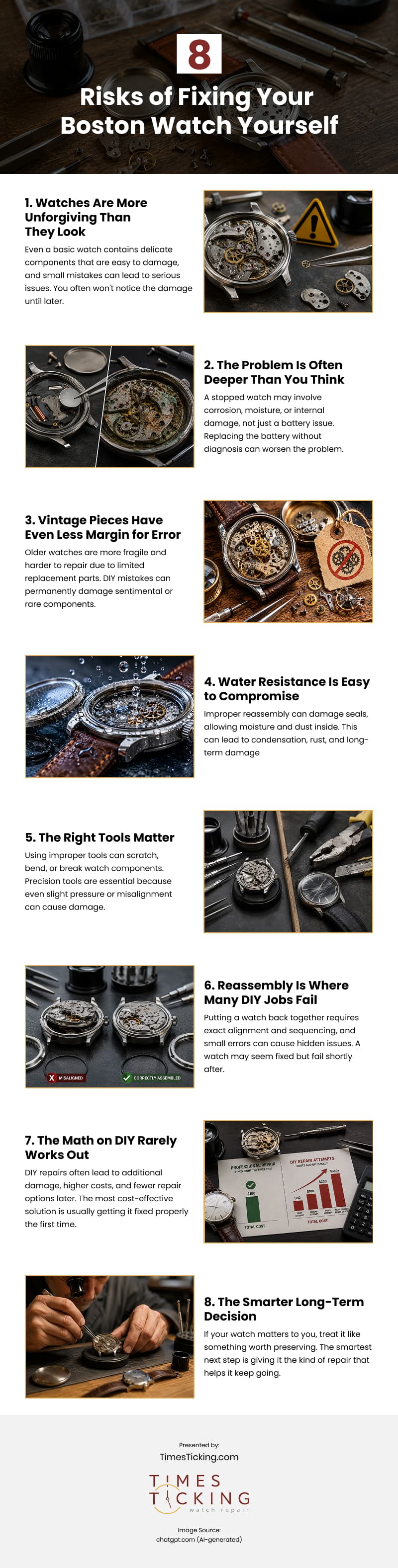
Infographic
Watches may appear simple, but their intricate internal mechanisms demand precision and expert handling during repairs. Attempting to fix a watch on your own can cause even more damage than the original issue. Explore this infographic to learn about the risks of DIY watch repairs.
Video